


Introduction
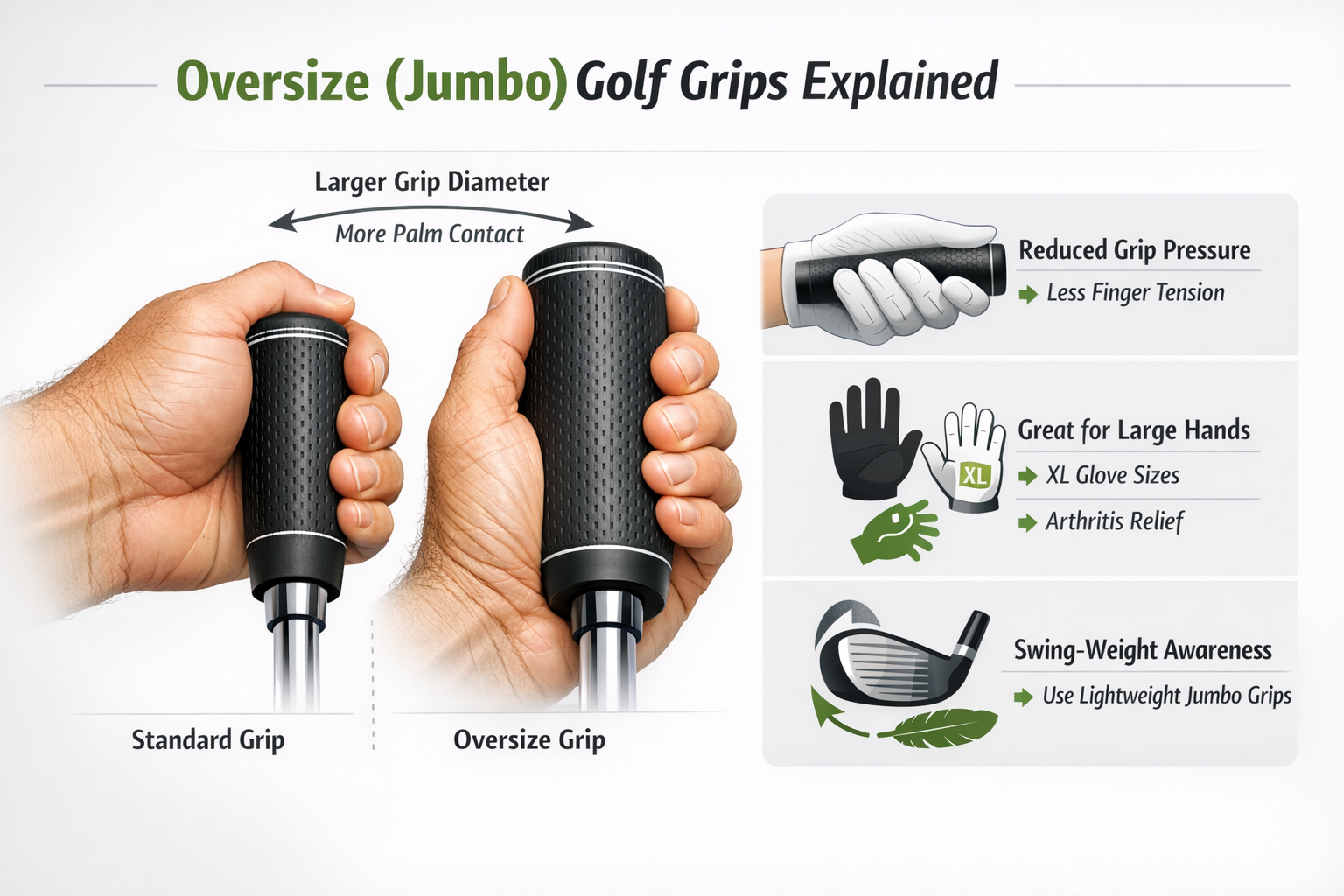
Oversize, or jumbo, golf grips are designed to increase the diameter of the club handle, changing how your hands interact with the club. By providing more surface area under the fingers and palm, these grips reduce the need to squeeze tightly, helping many golfers feel more relaxed and in control throughout the swing. The result is often less hand tension, smoother tempo, and improved consistency, especially for players who struggle with grip pressure. Jumbo grips are particularly beneficial for golfers with large hands, those who require XL or larger glove sizes, and players experiencing arthritis, joint pain, or hand fatigue. They can also help golfers who tend to over-grip the club under pressure, as the thicker profile naturally encourages a lighter hold. However, oversize grips are not a one-size-fits-all solution; factors such as grip weight, material, and swing-weight balance play a crucial role in overall performance.
Quick verdict
Try oversize/jumbo grips if you meet one or more of these:
- Glove size is XL or larger, or your fingertip-to-palm (middle finger tip → base of palm) measurement is in the 9.1–10.0 in range (recommendation used by manufacturers and independent testers).
- You feel excessive squeezing at the address and under pressure; a thicker grip encourages lighter finger pressure and more palm contact.
- You have arthritis or joint pain in the hands, thicker, softer grips often lower pain and make a full round more comfortable.
- You want to test a putter/wedge first; these are low-risk clubs to trial before changing an entire set.
- If you worry about swing-weight, choose engineered lightweight jumbo designs (for example, Jumbomax JMX UltraLite).
What is an oversize/jumbo grip?
An oversize (jumbo) grip increases the handle’s circumference versus a standard grip. Manufacturers use terms such as midsize, oversize, jumbo, or super-jumbo to describe progressively thicker profiles. Practically, this means more material under the fingers and palm, which lets you hold the club with less finger pressure and more palm contact. Typical increases in diameter vary by model; small midsize changes might be +1/16″, while jumbo and super-jumbo profiles can add +1/8″ up to +3/8″ (or more) when compared to a standard grip, depending on manufacturer and taper. Always check the manufacturer’s measurements before you buy.
Benefits & downsides
Benefits (concise)
- Reduces grip pressure and tension. A thick handle encourages you to hold with more palm and less finger, which can lower forearm and wrist tension and stabilize tempo.
- Better for large hands / XL glove sizes. If your hands are large, a standard grip can force cramped finger positions and extra pressure; an oversize grip restores a more natural hold.
- Relief for arthritis / joint pain. Softer, larger-diameter grips let more of the palm share the load; many with joint issues report immediate comfort.
- Consistent hand placement. Some oversize models are shaped with ridges or alignment features to promote repeatable hand position (e.g., ALIGN technology in certain Golf Pride models).
Downsides (short and honest)
- Reduced Feel. Thicker grips inherently reduce the amount of tactile feedback at the fingertips that can affect delicate shots and putting feel.
- Possible swing-weight change. Some oversize grips are heavier and can change the club’s balance unless you pick an engineered-lightweight option. (See JMX UltraLite for a lightweight response.)
- Not a mechanical fix. If your problems stem from setup or swing mechanics, a grip change will not magically correct them.
Do you need an oversize grip? a decision flow
Use this checklist as a practical “Do I try a jumbo?” flow:
- Measure your hand (method below).
- If fingertip → palm (base) < 8.5″ (≤216 mm): standard likely best.
- If 9.1″–10.0″ (231–254 mm): try jumbo/oversize.
- If glove size is XL or larger → try a jumbo.
- If you experience pain/numbness/arthritis → prefer softer, thicker profiles and test a wedge/putter first.
- If you find yourself over-gripping under pressure, test an oversize many people relax their hold with a thicker grip.
- Test & record: hit 50–100 baseline balls with your current grips, then 50–100 with a trial jumbo club; measure dispersion, distance variance, and subjective comfort.
How to measure your hand & a printable size chart
Measurement method (simple, printable)
- Open your lead hand (left for right-handed golfers, right for left-handed).
- Place your hand flat, fingers together.
- Measure from the tip of the middle finger to the crease at the base of the palm (not the wrist). Use a steel rule or measuring tape in inches or mm.
- Repeat 3 times and average.
Rule-of-thumb chart
| Hand length (tip → palm) | Glove size guide | Grip size recommendation |
| < 8.5″ (≤216 mm) | S–M | Standard |
| 8.5″ – 9.0″ (216–229 mm) | M–L | Midsize |
| 9.1″ – 10.0″ (231–254 mm) | XL / 2XL | Jumbo / Oversize |
| > 10.0″ (>254 mm) | 2XL+ | Super-jumbo / specialty |
(Manufacturer guides, such as Golf Pride, and independent testers use similar guidance include printable graphics on the page.)
Top oversize grip models
Below are editors’/industry picks to cover a range of priorities: lightweight engineering, hybrid shapes, high-tack comfort, and arthritic-specific profiles. Short bullets keep the page scannable.
1. JumboMax JMX UltraLite Best engineered jumbo
Why: Very large diameter with lightweight construction, so swing-weight change is mi,nimal. This model was developed to be substantially lighter than many jumbo grips, reducing the trade-off between diameter and added mass.
Use case: Players with large hands or those testing jumbo for the first time and worried about swing-weight.
Pros: Engineered to be lightweight; preserves clubhead awareness.
Cons: Fewer texture/compound options compared to mainstream brands.
2. Golf Pride MCC Plus4 / MCC Plus4 ALIGN Best hybrid size + shape
Why: The Plus4 design increases lower-hand diameter (encouraging lighter lower-hand pressure). MCC blends cotton cord in the upper hand with a softer rubber lower for traction and feel; ALIGN adds a raised ridge for consistent hand placement.
Use case: Players who want lighter lower-hand grip pressure and consistent placement, especially in wet conditions.
Pros: Proven, tour-backed architecture; multiple compound options.
Cons: Not the thickest jumbo available; more of a hybrid profile.
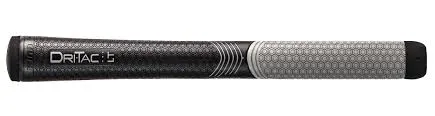
3. Winn Dri-TAC Oversize Best for tacky comfort & arthritis relief
Why: Winn’s Dri-Tac polymer (WinnDry) is very tacky and provides shock absorption. The oversize version is explicitly marketed as comfortable for Arthritic Hands.
Use case: Players seeking soft, gripping comfort in cold or wet conditions, and anyone prioritizing shock absorption.
Pros: Soft, tacky feel; comfortable.
Cons: Some players prefer firmer corded textures for traction.

4. Majek / arthritic-specific super-jumbo Best for severe joint issues
Why: Specialist manufacturers offer super-jumbo, low-taper profiles that maximize palm contact and minimize finger strain. These are specialist therapeutic products and often have limited distribution.
Use case: Severe arthritis, tremors, or therapeutic needs.
Pros: Designed specifically to reduce joint strain.
Cons: Reduced fine feel; limited availability and higher price.
5. Lamkin Crossline Oversize / Lamkin Sonar+ Best value oversize
Why: Lamkin’s Crossline pattern offers traction and durability at a competitive price, available in oversize profiles for players who want value and durability.
Use case: Budget-conscious players testing changes.
Pros: Affordable, proven traction, and durability.
Cons: Less premium compound feel compared with boutique grips.
Comparison table, quick specs & ideal use
| Model | Size range (approx) | Weight notes | Best for | Quick note |
| JumboMax JMX UltraLite | Jumbo → X-large | Engineered lightweight | Large hands/arthritis | Minimizes swing-weight change. |
| Golf Pride MCC Plus4 / ALIGN | Midsize → Oversize | Mid weight | Lighter lower-hand pressure | Hybrid compound + alignment ridge. |
| Winn Dri-TAC Oversize | Oversize | Average (~50 g typical) | Comfort & wet play | Very tacky; shock absorbing. |
| Majek / Arthritic super-jumbo | Super-jumbo | Varies | Severe arthritis | Therapeutic profile, minimal taper. |
| Lamkin Crossline Oversize | Oversize | Low–mid | Budget test | Durable, tour-proven pattern. |

How we test grips: a repeatable, publishable protocol
To outrank listicles, publish a transparent, reproducible protocol so readers and editors can replicate or judge your claims.
Sample size & clubs
- Test 5 popular oversize grips (examples: the five above).
- Use three clubs: 7-iron, wedge (PW or SW), and putter.
Objective metrics (what to measure)
- Circumference (mm) measured with a caliper.
- Mass (g) using a precision scale.
- Tackiness: 1–10 scale using a fixed contact time under standardized force.
- Wet traction: coefficient of friction in controlled dampness with a hand simulator.
- Durability: accelerated wear for 1,000 cycles; report tackiness loss.
- Swing-weight change: measure before/after with a standard swing-weight scale.
Subjective testing
- Panel: 10 golfers (5 left-hand, 5 standard).
- Protocol: Each player does 50 shots with baseline grips, then 50 shots with the trial jumbo grips. Record subjective grip pressure, dispersion, distance variance, comfort rating, and any feel notes.
Reporting
- Publish raw metric tables (circumference, weight, swing-weight delta), photos, and measurement videos. Transparency attracts backlinks and editorial trust.
Step-by-step regrip & installation
A printable regrip checklist is high-value content for readers. Include an image for every step if possible.
Tools & materials
- New grip(s)
- Double-sided grip tape
- Grip solvent (or rubbing alcohol)
- Hook blade/utility knife
- Vice with shaft clamp (optional)
- Cloth/rag & gloves
- Ferrule & finishing tape
Instructions (concise)
- Secure the club. Place the shaft in a vice (use a shaft protector) or hold firmly.
- Remove the old grip. Cut longways with a hook blade and peel the old grip off.
- Clean shaft. Remove existing adhesive and residue with solvent; dry.
- Apply double-sided tape. Start at the butt and wrap toward the tip; smooth bubbles.
- Butt fill (optional). Add or remove under-tape to adjust taper/feel.
- Pour grip solvent. Evenly down the taped shaft; rotate to coat the interior.
- Slide the new grip on. Quickly align logos and push fully seated; twist slightly to orient.
- Wipe excess solvent. Ensure alignment and remove spills.
- Cure. Allow manufacturer-recommended cure, typically 4–6 hours, before play.
- Test. Hit practice shots to verify rotation and feel.
Care, cleaning & when to replace
- Cleaning: Warm water + mild soap periodically (every 5–10 rounds or when tackiness drops). Wipe and air dry. Avoid harsh solvents on some compounds.
- Replacement triggers: Visible cracking, significant loss of tack, deformation, or change in circumference. Typical lifespan: 1–2 seasons, depending on play frequency and grip compound.
- Storage tip: Avoid leaving clubs in hot cars; heat accelerates compound degradation.
How to choose the right oversize grip
- Measure your hand (use the printable chart).
- Decide priorities: comfort vs feel vs swing-weight control.
- Choose material: corded for traction; rubber/composite for comfort.
- Weight matters: choose lightweight engineered jumbo if swing-weight is a concern (e.g., Jumbomax UltraLite).
- Try before you change: test a wedge or putter for 2–3 practice sessions.
- Combo approach: many players use jumbos on wedges/putter only and standard on long clubs.
Common mistakes to avoid when buying oversize grips
- Buying the thickest grip without testing first. Feel matters.
- Ignoring grip weight and swing-weight implications.
- Regripping your full bag immediately trial a single club to compare.
- Choosing a compound that doesn’t suit the climate (e.g., very soft tacky compounds in hot climates may degrade faster).
Pricing & availability
- Provide price ranges and affiliate buy buttons with transparent MSRP and typical online price.
- Offer a “where to try” section: local pro-shops often let you demo a putter grip or have demo wedges. Encourage readers to test in-shop.
FAQs
A: Not inherently. A well-engineered lightweight jumbo will have minimal effect. If a grip is heavy and changes swing-weight significantly, you may notice small distance changes. Test on wedges/putters first and monitor.
A: Yes. The Rules of Golf permit thicker grips, but grips must meet equipment rules; cross-sectional dimensions may not exceed 1.75 inches (44.45 mm), and grips must not be molded for any part of the hands. Check local committee rules for elite events.
A: Many players trial jumbos on wedges/putters first. Drivers require tactile feel for launch and twist; some players prefer standard or midsize for drivers. Consider a combo approach.
A: A single regrip using proper tools takes ~15–30 minutes for one club; allow 4–6 hours cure time before play. If regripping many clubs, plan accordingly or use a pro shop.
Conclusion
Oversized golf grips aren’t a trend or a shortcut; they’re a fit solution. When grip size matches your hands, Pressure Drops, tension eases, and the club feels like a natural extension rather than something you’re fighting. For golfers with large hands, XL glove sizes, arthritis, or a habit of squeezing the handle under pressure, switching to an oversize grip can immediately improve comfort and consistency without changing swing mechanics.