


Introduction
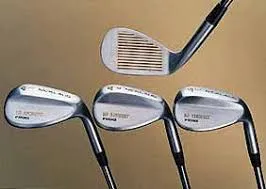
Golf Wedges are the shortest and most personal clubs in your bag. A well-configured wedge setup converts missed greens into routine up-and-downs. This guide explains how wedges work, how to choose loft, bounce, and grind, how to gap your scoring clubs, and which wedges tested best in 2024–2026. It’s written to be actionable, so you can make better buying choices quickly.
How wedges work: loft, bounce, grind & grooves.
Wedges are not just “short irons with more loft.” They are short-game tools engineered for trajectory control, spin, and turf interaction. Master these four concepts, and most wedge choices become obvious.
Loft the angle of the clubface. Higher loft produces higher launch and usually more spin. Typical modern wedge lofts span roughly 46° to 64°; common scoring wedges are 50°–58°.
Bounce the angle between the leading edge and the lowest point of the sole. Bounce prevents the club from digging in soft sand or turf by letting the sole ride (or “bounce”) through the turf. More bounce (10°+) helps soft conditions; lower bounce (4°–6°) suits firmer turf and shots that need the leading edge close to the ground.
Grind how the sole is shaped across the toe, heel, and trailing edge. Grind changes how the club reacts when opened or closed and determines the playable range of the wedge. A narrow sole and limited grind favors precision shotmakers; wider soles and trailing-edge relief favor bunker play and forgiving shots.
Grooves & face texture grooves channel debris, grass, and moisture to maintain friction between ball and face. Modern wedges pair groove geometry with micro-etching or “spin tread” treatments to sustain spin in damp conditions. Groove wear reduces spin over time.
Why fitting matters: the same model can feel very different with different loft/bounce/grind specifications. Manufacturers ship multiple options; picking the wrong combination can make excellent wedge designs play poorly for your swing and turf. A correct fit reduces misses and increases up-and-down percentages.
Wedge types what to pick by skill level
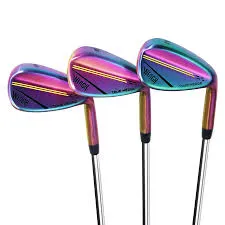
Wedges broadly fall into three buckets. Choose the bucket that matches your swing, control needs, and playing surfaces.
2.1 Tour / Player Wedges (blade-style)
Profile: Thin soles, compact head, emphasis on feel and workability.
Best for: Low handicappers who control contact and shape shots.
Why: Maximum feedback and shot-making, but less forgiveness on mishits.
2.2 Mid / Performance Wedges
Profile: Milled Faces, blended grinds, moderate sole width.
Best for: Mid-handicappers who want a balance of spin, versatility, and forgiveness.
Why: Versatile across lies; good for players who mix full swings and finesse shots.
2.3 Game-Improvement / Cavity-back Wedges
Profile: Deeper center of gravity, wider soles, more offset, and forgiveness.
Best for: High handicappers who need consistent contact and less distance loss on mis-hits.
Why: Simplifies scoring shots and reduces the penalty of slightly fat or thin strikes.
Quick picking rules
- Steep attack angle + soft turf → opt for more bounce (10°+).
- Shallow attack + firm turf → choose less bounce (4°–6°).
- If you open the face often → pick grinds with toe/heel relief or trailing-edge relief to avoid the club sticking.
- Play in wet climates → consider wedges with micro-grooves or surface spin treatments.
A 9-step wedge fitting checklist
Treat a wedge fitting like a focused mini-session. Bring a notebook or use your phone to record numbers.
- Measure your current lofts. Use a loft gauge or ask a pro. Record PW and all wedges in degrees. Many players discover odd factory lofts and unexpected overlaps.
- Record carry distances. Measure full, ¾, and ½ swing carry distances on the range or with a launch monitor.
- Decide your target gaps. Aim for consistent 4°–6° gaps between scoring clubs (4° = tight; 6° = more forgiving).
- Assess attack angle & turf. Are you a steep digger or a sweeping shallow player? What are your home-course turf conditions: firm, mixed, or soft?
- Choose bounce by swing & ground. Steep + soft → 10°+. Shallow + firm → 4°–6°.
- Select grinds for shot needs. If you open the face frequently, prioritize grinds with toe/heel relief. If bunkers are a big part of your short game, look for trailing-edge relief and wider sole options.
- Test three wedges on-course. Play holes using each option, evaluate full wedge shots, pitches, chips, and bunker shots. Range feel isn’t everything.
- Lock shafts & grips. Wedge shafts affect feel and torque. Match to your irons or choose wedge-specific shafts. Adjust grip thickness for a consistent feel.
- Re-evaluate after real play. After ~10 rounds, reassess and tweak lofts/bounce if needed. Course play reveals issues a hitting bay won’t show.
Make this checklist a one-page PDF for email capture, it’s high perceived value for learners and club-fitters.
Wedge loft & bounce gapping charts
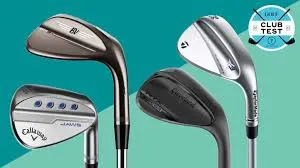
Use these sample patterns as starting points. Always confirm on-course.
Sample A Low-handicap / Player setup
PW 44° → 48° (gap) → 52° (SW) → 56°/58° (LW)
Bounce: 6° (48°), 4°–6° (52°), 4° (56°/58°)
Use: precision, shotmaking.
Sample B Mid-handicap / Performance setup
PW 46° → 50° (AW) → 54° (SW) → 58° (LW)
Bounce: 8° (50°), 8°–10° (54°), 10° (58°)
Use: versatile across turf types and partial/full shots.
Sample C High-handicap / Forgiveness setup
PW 46° → 52° → 56° → optional 60°
Bounce: 10°–12° across scoring wedges
Use: prevents digging and simplifies club choices.
Why gapping matters: Uneven gaps create distance holes that force awkward partial swings. Partial swings are less repeatable; even gaps make club selection simple and scoring more predictable.
Example: If your PW is 46°, and you want ~5° gaps, select 50° and 55° (or 50°/54°/58°). Many players prefer a 58° with a playable grind rather than an infrequently used 60°.
Best wedges 2026 top picks by category
Below are concise, test-backed recommendations drawn from independent lab testing, Hot List evaluations, and community feedback across 2024–2026 testing cycles. Use these as starting points for your shortlist.
- Best Overall Mizuno Pro T-3
Why: Outstanding feel and consistent spin with top lab metrics.
Who it suits: Low to mid handicappers seeking feel + performance. - Best for Spin / Tour Feel: TaylorMade Milled Grind 5
Why: Milled face machining and spin tech deliver a strong bite on partials.
Who it suits: Players wanting maximum stopping power and consistent partial-spin performance. - Best for Forgiveness Cleveland RTZ (and RTZ family)
Why: Excellent accuracy and spin retention in wet conditions; strong value.
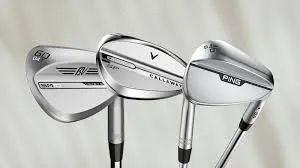
Who it suits: Mid-to-high handicappers prioritizing value and consistent turf interaction. - Best Tour Choice Titleist Vokey (SM10 family)
Why: Broad selection of loft/bounce/grind combos; tour prevalence and unmatched grind variety.
Who it suits: Players who want the same configurability many pros use. - Best Value older RTX / Cleveland lines
Why: Legacy models with modern groove tech at lower price points; good used-market bargains.
Note on testing sources: Look for data from lab testers (spin, consistency), Hot List panels (real-player testing), and forums for Community Feedback. Combine objective test data with real-world impressions to finalize a shortlist.
Wedge setup examples, real, playable
Pick one template and adapt via the 9-step checklist.
Low-handicap / Shotmaker
PW 44° → 48° → 52° SW (narrow, ~10° bounce) → 56° LW (trimmed, ~4° bounce)
Reason: Tight gaps and narrow soles for precise shaping and controlled spin.
Mid-handicap / All-around
PW 46° → 50° AW (8° bounce) → 54° SW (10° bounce) → 58° LW (10° bounce)
Reason: Even distance coverage and grinds that suit mixed turf.
High-handicap / Forgiveness
PW 46° → 52° → 56° (10°–12° bounce)
Reason: Fewer clubs, higher bounce to prevent digging, and simplify short-game decisions.
When to add a 60°: Only add if you regularly need high flop shots around the green. Many players are better off with a 58° and a grind that opens easily instead of carrying an underused 60 °.
Maintenance: groove care, re-grinding & when to replace wedges
Groove wear: Groove wear and spin reduce gradually. If you play frequently, inspect grooves annually. Replace when grooves look rounded, or spin declines noticeably.
Cleaning: Clean grooves after each round with a stiff brush and warm water. Avoid metal scouring that damages micro-texture.
Re-grinding: Re-grinding changes sole geometry to match new shot styles. Use an experienced clubmaker; improper grinding can wreck loft/bounce balance.
When to replace: Regular players often see replacement windows of 18–36 months, depending on rounds and conditions. Replace earlier if spin or distance consistency drops.
Pros & cons
Pros of fitted wedges
- Better stopping power and control.
- More consistent scoring when lofts and gaps are right.
- Bounce & grind choices prevent digging and broaden shot options.
Cons/tradeoffs
- Over-specializing with too many odd grinds or an unused 60° can create gapping issues.
- Premium wedges cost more, but last-year models and used options are worthwhile.
- The wrong shaft or grip can ruin feel and spin.
FAQs
Start by checking the gap between your pitching wedge (PW) and your next scoring club. A 50° or 52° usually follows a 46° PW. Aim for 4°–6° gaps.
Ideally, 4°–6° between clubs for consistent distance coverage
Yes. Bounce affects how the sole interacts with turf. More bounce prevents digging in soft conditions; less bounce suits firm turf and open-face shots.
Only if you regularly use high flop shots. Many players are better off with a 58° and a grind that opens easily.
Check grooves yearly if you play often. Replace when spin decreases noticeably, or grooves are rounded, typically 18–36 months for regular players.
Conclusion
Wedges are scoring clubs, and the right setup can make a noticeable difference in how often you save par and limit mistakes around the green. Rather than chasing brand names or tour trends, golfers should focus on Proper loft Gapping, suitable bounce, and the right grind for their swing and playing conditions. A well-fitted wedge set simplifies decision-making, improves contact from all lies, and delivers more consistent spin on partial shots. Whether you choose a tour-style blade, a performance wedge, or a more forgiving cavity-back design, success comes from matching the club to your technique, turf, and shot preferences.