



Introduction
Golf Sand plays a crucial role in bunker shots and overall course strategy. The type, depth, and firmness of sand directly affect how the club interacts with the ground and how the ball reacts at impact. Soft, fluffy sand allows for classic splash shots, while firm or compact sand requires a more precise, descending strike. By understand Golf sand plays a crucial role in bunker shots and overall course strategy. The type, depth, and firmness of sand directly affect how the club interacts with the ground and how the ball reacts at impact. Soft, fluffy sand allows for classic splash shots, while firm or compact sand requires a more precise, descending strike.
What is “golf sand” and why does it matters
When players say “bunker sand,” they usually mean whatever material fills the hazard on the course. From a grounds and agronomy perspective, the materials used around greens (topdressing sands, rootzone mixes) and bunker sand are distinct but related, and both change how your short game behaves.
Three measurable sand attributes most affect play:
- Particle size (gradation): grain diameter distribution controls firmness and how the club moves through the material.
- Grain shape/angularity: jagged, angular grains lock together and resist club penetration more than rounded grains.
- Fines (silt & clay content): tiny particles make sand cohesive and crusty; too many fines cause poor drainage and unpredictable lies.
Put simply: particle size + shape + fines determine drainage, firmness, and whether your club will “bite” or “skip” through the sand. A single swing that produces a clean splash in a soft, round-grained bunker can produce a skull or a heavy “chunk” in compact, angular sand. Reading the sand before you choose a wedge and a set-up is the single biggest lever for consistent bunker play.

How sand type changes shots
Soft, deep sand
- Plays like a “splash.” The ball often sits up; the surface gives way.
- Technique: open the face more, use a higher bounce, and swing to move sand rather than contacting the ball directly. The goal is to remove a shallow wedge-full of sand under the ball.Firm/compact sand
- Acts much more like turf. The ball sits lower, and sand resists less lateral deformation.
- Technique: square the face (or usea slight opening only), take a steeper, descending strike, and consider a lower-bounce wedge or a square leading edge to avoid excessive bounce that can cause thin strikes.
Plugged /wet/heavy sand
- Unpredictable. Fines and moisture bind the grains; sand can behave like clay.
- Technique: steeper, firmer blow; sometimes choosea lower loft and play a running escape if greenside spin and stopping power are compromised.
Quick rule: soft sand → more open face + more bounce; firm sand → less opening + lower bounce. Always adjust by feel and visual cues.
Greenside bunker fundamentals:
These four fundamentals form the repeatable routine that separates confident bunker players from tentative ones.
Setup & stance
- Feet: Slightly open stance (aim a little left of the target for right-handers).
- Stability: Dig your feet in lightly. That provides a stable base and prevents early weight shift backward. Distribute ~55–60% of your weight on the front foot.
- Face: Open the clubface to the amount of loft you need.
Ball and aim point
- Ball position: Slightly forward of center (closer to the front foot) for the classic “splash.”
- Aim point for contact: Not the ball, a spot 1–2 inches behind the ball. You aim to strike that sand point and slide the club under the ball. This is the most commonly missed cue for novices.
Strike intent & acceleration
- Think move the sand rather than hihittinghe ball.
- Accelerate through contact. Keepthe lower body stable and rotate the torso through. Avoid decelerating at impact; halting causes fat or thin strikes.
Allow-through & finish
- Commit to the finish. Since you are striking the sand, a full follow-through is normal. Distance is determined by swing length and sand taken t by the sensation of “catching” the ball.
Classic practice drill: Place a small towel 1–2″ behind the ball and practice removing it on the swing. If you remove the towel consistently, you are hitting the sand first and committing to acceleration.

Fairway bunkers require a different mindset.
Fairway Bunker shots are frequently longer, have a different lie,e and often require more of an iron-like approach.
Key differences:
- Stance: narrower than greenside bunker stance.
- Ball position: more centered, or slightly back,k depending on the club and desired trajectory.
- Face: square or slightly closed. You usually don’t open the face here.
- Swing: compact, controlled, and aimed at clean center-face contact.
- Club selection: add a club rather than swing harder if the stance is short.
If the ball sits cleanly, treat many fairway bunker shots like normal approach shots, with a controlled iron swing to the target. Save open-face, high-bounce splash techniques for true greenside situations.
Hard / plugged / wet sand advanced adjustments
When sand is compact or “plugged,” you lose the splash cushion. Adjustments:
- Square the face more (avoid excessive opening).
- Move the ball slightly back to induce a steeper attack angle.
- Use a firmer descending strike to penetrate the compact surface.
- Switch clubs if needed. Very tight, shallow lies, a lower-lofted wedge, or a bump-and-run may be safer than risking a skull.
Pro coaches often use side-by-side video to show the tactile difference between soft and hard sand swings. Consider adding short video clips or GIFs to your pillar page illustrating both techniques.
Choosing the right sand wedge: loft, bounce & grind
Loft
Most sand wedges fall between 54° and 5 °. Some brands offer 52° or 60° models for gapping or specialised distance control. Loft influences launch angle and stopping ability; pick a loft that fills the gaps between your gap wedge and lob wedge.
Bounce
Bounce is the angle between the leading edge and the lowest point of the sole. It determines whether the club will dig or glide on contact.
- High bounce (10°+) is better for soft/deep sand and steep attack angles.
- Medium bounce (8°–10°) versatile, good for mixed conditions.
- Low bounce (6°–8° or less) suited for firm, tight lies.
Grind
Grind refers to the process by which the sole is shaped. Different grinds change how the club behaves when opened or closed.
- Mid-grin versatile.
- Wide sole / high-bounce grinds de over sand and minimizes digging.
- Specialist grinds osen by tour players to match their specific course conditions and attack angles.
How to choose
- Know your home course sand (soft vs firm).
- If unsure, choose a mid-bounce wedge (8°–10°) with a versatile grind.
- Test in a practice bunker that matches your course conditions before making a purchase.
6-Week bunker practice plan
Goal: Reliable greenside exits and a higher scramble conversion from bunker lies.
Weekly KPIs (simple)
- Week 1: Hit sand 8/10 times behind towel drill.
- Week 2: 10 shots at 10/20/30 yards with consistent sand contact (target: 6/10 within target circle).
- Week 3: Reproduce soft & firm sand shots 70% recoveries.
- Week 4: Pressure game score 24+ in a 6-shot points game.
- Week 5: On-course simulation, place 3 approach shots per round with bunker shots; record outcomes.
- Week 6: Video review, compare to the pro reference, and refine.
Daily sessions: 20–40 minutes.
Micro plan day-to-day
Mechanics (10–20 min/day)
- Towel drill (towel 1–2″ behind ball): 30 reps.
- Stability drills: 20 half-swing,s keeping weight forward.
Distance control (20–30 min/day)
- 3-distance ladder: 10 shots to targets at ~8–10 yds, 12–15 yds, 20–25 yds. Track clubface opening and swing length.
Mixed lies (20–30 min/day)Week 3
- Practice the same shot from a soft pile and a compact patch.
- Fairway bunker work: 40–80 yd targets; focus on center-face contact.
Pressure drilling Week 4 (30 min/day)
- 6-shot target game: 2 points for within 6 ft, 1 point within 15 ft. Play three rounds; aim 12+.
Week 5 On-course simulation
- Replace 3 approach-type shots in a practice round with bunker shots. Log outcomes (greens hit, up-and-downs, total strokes).
6 Week Integration & video
- Film 10 swings; compare tothe reference pro footage. Make two small, implementable adjustments and repeat.
Core drills to keep in your kit:
- Towel drill (must).
- Narrow-stance fairway bunker control swings.
- Target ladder for distance control.
- 6-shot pressure game.
Add a short hero video and three looping GIFs (setup, impact, finish) on the page for reader retention.
Course sand & maintenance: what grounds crews test
Grounds crews and sand suppliers test bunker sands for several parameters:
- Particle Gradation distribution): most bunker sands perform best when a majority of grains fall in a range roughly between 0.25–1.0 mm (exact spec varies). This affects firmness and wind erosion.
- Silt & clay content (fines): keep total silt + clay low (many suppliers target <3%). Too many fines cause crusting and poor drainage.Angularity/grain shape: angular silica sands interlock and compact; round grains typically produce a “softer” splash.Infiltration/drainage rate: measured to ensure bunkers shed water and don’t pond.
- Grain cleanliness: washed sands reduce crust formation and maintain consistent play.
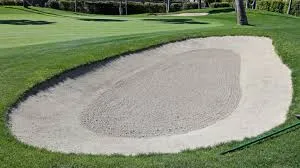
For golfers: more fines = more crust and unpredictability; round, clean grains = softer splash; angular, coarse grains = firmer, more consistent reaction.
Common mistakes, troubleshooting & quick fixes
Chunking (fat shot)
- Cause: not committing to follow-through orweight back.
- Fix: towel drill, keep weight forward, swing through.
Thin shot (skull)
- Cause: early body rise or trying to lift the ball.
- Fix: keepthe chest behind the ball at impact; aim to hitthe sand 1–2″ behind the ball.
Wrong wedge choice
- Cause: using a low-bounce wedge in soft sand.
- Fix: choose a higher bounce for soft sand; mid/low bounce for firm sand.
Over-opening in firm sand
- Cause: assuming all bunkers need an open face.
- Fix: square the face more on compact sand and hit a steeper blow.
Pros & Cons
Pros of mastering bunker play
- Big score savings or game wins in holes.
- Confidence under pressure.
- Greater short-game versatility.Cons/challenges
- Requires repetition and deliberate practice.
- Equipment mismatch (wrong bounce or grind) slows progress.
- Course sand variability forces frequent adjustment.
FAQs
A1: Most sand wedges are 54°–58°, but some models include 52° or 60° options depending on gapping.
A2: No guarantee, but consistency comes from a simple routine: stability, ball forward (greenside), aim 1–2″ behind the ball, accelerate and commit to the follow-through. Practice the towel drill and use the correct bounce.
A3: No. Opening helps in soft sand. In firm or compact sand, square the face and use a steeper strike.
A4: Bounce helps the club glide instead of dig. High bounce for soft sand, low bounce for firm/tight lies.
A5: There is no single best. Choose a mid-bounce (8°–10°) with a versatile grind if you play mixed conditions. Test in a practice bunker first.
Conclusion
Bunkers will remain part of golf’s narrative, but with a Structured Approach t, they stop being a liability and become a routine you can master. Start with the 4-step fundamentals (setup, aim, strike intent, follow-through), adapt to sand type, and choose wedges that match your home course conditions.