



Introduction
Golf Putting decides more rounds than most shots. You’ll face putts on every hole; a putter that matches your stroke and setup can shave multiple strokes immediately. Too many golfers buy by looks, brand, or price, not by fit. This guide gives a clear, repeatable, evidence-backed system to pick the right putter (blade vs mallet), fit length/lie and shaft placement, interpret lab test data in real terms, and practice drills that transfer to scoring.
What is a putter and why does it matters
In plain terms, the putter is the club you use to roll the ball into the hole across the green. In systems thinking and in scoring models, it’s the lowest-variance instrument in your bag, small changes in roll, alignment, launch, or tempo compound across 18 holes. A well-fitted putter simplifies alignment, reduces unwanted rotation (a.k.a. face twist), improves launch, and makes distance control more predictable. Think of it as selecting a model architecture that matches your data distribution: a mismatch increases error (missed putts). A putter that fits your stroke reduces noise and lets your practiced skills express themselves, producing immediate stroke savings.
How putters differ
We can think of putters like families of model architectures and hyperparameters. Three primary axes differentiate putters: head geometry (architecture), balance / toe-hang (dynamics), and shaft entry (interface). Secondary axes are materials and face engineering (materials + activation functions).
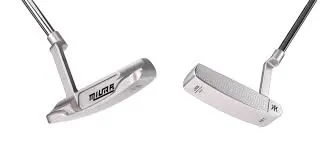
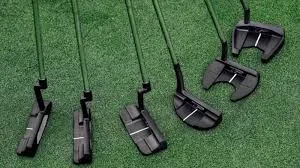
Head shapes: Blade, Mallet, Mid / Half-mallet.
- Blade: Narrow, low-profile architecture. Blades are like lightweight sequence models: high sensitivity, high expressivity, and they require a well-regularized stroke (good technique). Players who value shot-shaping and precise feel favor blades because they deliver instant, high-resolution feedback on face rotation and stroke path.Blades often pair with heel-shaft entries and larger toe-hang, suiting arc strokes.
- Mallet:High-MOI (moment of inertia) designs emphasize stability and forgiveness. Mallet putters behave like ensemble systems that reduce inconsistency, improving overall results while giving up some fine-tuned control. Most mallets lean toward face-balanced, center-shafted setups, suiting straight-back, straight-through strokes and players who rely on strong alignment aids.They reduce face rotation and produce more consistent starts to roll.
- Mid / Half-mallet: Hybrid architectures that trade some feel for added stability. If you’re looking for a mix of blade feel and mallet forgiveness, this category is worth exploring.
Balance Face-balanced vs Toe-hang
Balance is the putter’s dynamic prior: does the head resist rotation, or does it allow rotation?
- Face-balanced designs resist rotation (the face stays neutral when resting on a finger). They match straight-line strokes and reduce the need to manage face rotation actively.
- Toe-hang designs have a natural rotational bias (the toe drops when balanced) and are better suited to arc strokes. More toe-hang → more rotation during the stroke → better for players who naturally swing on an arc.
Rule-of-thumb (a simple classifier): face-balance → straight stroke; toe-hang → arc stroke.
Shaft entry Center vs Heel
- Center-shafted: Interface in the middle of the head produces a straighter response and is common on face-balanced putters. It’s functionally similar to a centered input layer that stabilizes outputs.
- Heel-shafted: Offset interface near the heel increases toe motion and is common on toe-hang blades. It changes the head’s rotational inertia and feel at impact.
Materials & face technology
- Milled Stainless Steel: High-density, consistent, and predictable sensory feedback (think deterministic floating-point math). Premium milled heads give a crisp feel and consistent contact.
- Face inserts (polymer/urethane): These alter acoustic and tactile response, usually softening feel and sometimes improving early roll (reduced skidding).
- Engineered face geometries: Grooves and microstructures aim to improve initial roll by reducing skid and promoting immediate forward roll, akin to an algorithmic bias that reduces transient error.
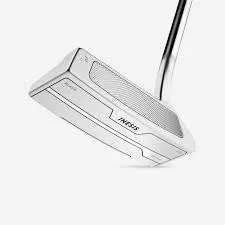
How modern labs test putters and what the numbers mean to your score
Modern testing rigs combine high-speed imaging, consistent mechanical rigs, and launch-monitor-like sensors to measure key performance metrics repeatably. Think of labs as controlled A/B testing platforms for putter models.
Typical lab metrics:
- Short make % (3–8 ft): measured probability of drop for short-range stochastic outcomes.
- Mid-distance control (8–20 ft): average residual distance left on misses; critical for reducing three-putt frequency.
- Long distance roll (20+ ft): dispersion (lateral spread) and finish distance; informs predictable putt finishes.
- Launch/roll characteristics: initial launch angle and forward roll development (skid-to-roll transition).
- Repeatability: how tight the distribution of outcomes is over many replicates (variance measurement).
Why that matters to your score: For most amateurs, mid-range distance control (12–20 ft) has the biggest marginal effect on reducing three-putts and saving strokes. A putter that reduces average residual distance from, say, 5 ft to 3 ft on missed mid-range putts is functionally reducing three-putt probability a lot.
Which putter is right for you? The three-question decision flow
Below is a concise decision flow that maps your stroke and priorities into candidate architectures. The three questions must remain the same exactly as written.
Q1 What is your stroke arc?
- Straight back / straight through → face-balanced, center-shaft or mallet.
- Slight to moderate arc → toe-hang, heel-shaft, blade or half-mallet.
- Strong arc → higher toe-hang blades.
Q2 What do you prioritize?
- Line + forgiveness → mallet with bold alignment
- Feel + workability → blade, milled face.
Q3 What’s your budget?
- Under $150 → value mallets/entry blades.
- $150–$350 → mid-tier (Odyssey, Ping, TaylorMade).
- $350+ → premium milled (Scotty Cameron, Bettinardi, Toulon).
Top putters to consider quick comparison table
| Use-case | Example models (popular) | Why this pick | Typical price band |
| Best Overall (tour feel + consistency) | Scotty Cameron Studio/Select, Bettinardi | Premium milling, consistent feel, tour-proven | $350+ |
| Best for alignment & forgiveness | Odyssey Ai, TaylorMade Spider | High MOI, bold sightlines, steady roll | $150–$350 |
| Best value under $150 | Odyssey White Hot (value), Wilson entry mallets | Solid feel and alignment for budget buyers | <$150 |
| Best for arc stroke | Heel-shaft blades (various) | Toe-hang + workability | $150–$400 |
| Best for straight stroke | Center-shaft face-balanced models | Keeps face square for straight strokes | $150–$400 |
| Best distance control | High MOI mallets & engineered face rolls | Predictable long-putt roll | $150–$400 |
| Best beginner pick | Large mallet with alignment | Forgiving, easy setup, confidence builder | <$200 |
Note: Model availability and prices change. Use these as starting priors, always test.
Think of this checklist as a feature-capture form for your putter fitting session. Record each metric; these values become your personal model hyperparameters.
Length
- Standard: 33″, 34″, 35″.
- Symptoms of wrong length: hunched shoulders, wrist break, inconsistent aim.
- Home check: In your normal putting posture, your eyes should be over or slightly inside the ball-line.
Lie & Loft
- Lie influences heel/toe contact; an incorrect lie angle biases contact location.
- Loft: typical values are 2°–4°; correct loft helps the ball get into a forward roll quickly.
Grip Size
- Oversize: reduces wrist movement; can help with yips.
- Thin: more feel and feedback.
Head Weight & Toe-hang
- A heavier head stabilizes long putts but can reduce short feel.
- Measure the toe-hang degree and match it to your arc.
Measurements to record (example fields)
- Eye-line relative to ball (over / slightly inside / well inside)
- Usual stroke arc (straight/slight arc / strong arc)
- Preferred head shape (blade/mallet/mid)
- Grip preference (standard/midsize / jumbo)
- Current putter length (inches)
- Typical miss left/right at 10 ft and 30 ft (average)
- Green speed range (if known)
Printable: I can convert this checklist into a one-page PDF for printing and bringing to your fitting or practice sessions.
How to test putters at home step-by-step protocol
Treat your home test like an experiment: define controls, keep variables constant, and record outcomes.
What you need
- Putting a mat or a green, 4 tees, measuring tape, phone for video, pen, or spreadsheet.
Protocol
- Warm up (5 min): neutral putter to set tempo.
- Short make test (3–8 ft): 20 putts from each distance (3, 4, 6, 8 ft; 5 reps each). Record make %.
- Mid-distance control (12–20 ft): 10 putts; measure average distance left for misses; mark exact start distances.
- Long roll test (30 ft): 5 putts; measure average finish distance and lateral dispersion.
- Video: record from behind to analyze stroke arc and face angle at impact.
- Repeat: test 2–3 candidate putters with identical balls, stance, and conditions.
How to compare
- Rank by short make% first (confidence).
- Compare average distance left at mid/long ranges; lower is better for reducing 3-putts.
- Use a simple scoring sheet: short%, mid avg left (ft), long avg finish (ft).
6 drills to improve putting fast
These drills are transferable and evidence-backed: repetition with defined targets reduces variance and increases consistency.
- Gate Drill (face alignment) Place two tees slightly wider than the head, ~3 ft from the hole. Roll 20 putts through the gate without touching the tees. Focus on the face square at impact.
- Distance Ladder Place markers at 5, 10, 15, 20 ft. Putt to each, aiming for a 0–2 ft finish. Three reps each. Trains scaled stroke length for speed control.
- Clock Drill (short putting): 12 balls around the hole at 3 ft. Putt each; repeat twice. Builds repeatability and confidence.
- Head-still Roll Test 50 reps with head steady; accelerate through. Trains consistent contact and forward roll.
- One-arm Tempo Training: Use only your lead arm for 10 putts; improves tempo and body control.
- Pressure Knockout (practice pressure) Competitive reps: 5 balls at 5 ft; miss and you’re out. Simulates pressure and converts practice into performance.
Maintenance, travel & resale notes
- Cleaning: mild soap and a soft brush for milled faces; dry thoroughly.
- Protection: Use headcovers; avoid banging the head against hard surfaces.
- Travel: pack with headcovers in a padded travel bag; secure hosel and putter shaft to minimize movement.
- Resale: premium milled models maintain value better than mass-market insert designs. Keep receipts & covers.
Pros & Cons: what to watch out for
Pros of being fitted
- Immediate reduction in 3-putts if you match stroke to putter type.
- Increased confidence and more effective practice.
- Equipment aligns with skillset, less wasted practice.
Cons/cautions
- Buying for looks/brand rather than fit wastes money.
- Over-reliance on lab metrics without personal validation can mislead.
- Constantly switching putters prevents muscle memory.
FAQs
A: Mallets usually offer more forgiveness and alignment aids, helping golfers who need better line and consistency. Blades offer more feel and control for players with a repeatable stroke.
A: Balance the shaft on your finger. If the face points straight up and resists rotating, it’s face-balanced; if the toe drops, it has toe-hang.
A: A slightly heavier head can improve tempo and long-putt roll, but too heavy can reduce short-putt feel. Test both weights and track short make% vs long control.
A: Standard lengths are 33–35 inches. Your posture and eye-line should guide the final choice; a fitter can measure the exact ideal length.
A: Use tests (MyGolfSpy, Digest Hot List) for guidance, but always try ourself. Labsquantify differences, but your stroke and feel matter more.
Conclusion
Choosing the right golf putter is not about brand hype, looks, or price; it’s about fit, function, and Consistency. A putter that matches your stroke arc, head preference, and setup fundamentals will immediately improve alignment, distance control, and confidence on the greens. When you understand the differences between blade and mallet designs, face-balanced and toe-hang models, and how length, lie, and grip affect your stroke, buying a putter becomes a smart decision, not a guess. Use the three-question decision flow to narrow your options, test 2–3 putters using the at-home protocol, and commit to one putter with a focused practice plan. Most golfers will see faster improvement by reducing three-putts and improving mid-range distance control rather than chasing perfection from long range.