

Introduction
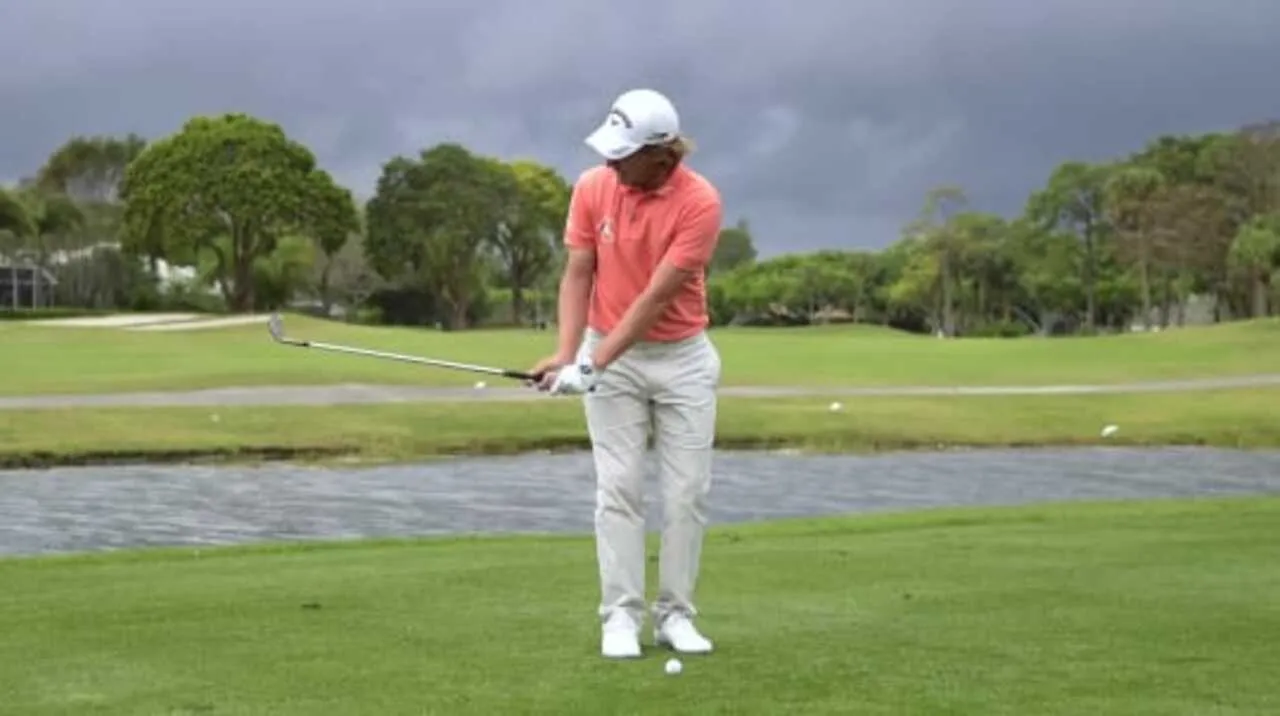
Golf Pitching is the short-game skill that separates consistent scorers from players who constantly scramble to save par. It’s the shot you rely on when the ball must fly most of the way, land softly, and stop close to the hole. Inside 100 yards, good pitching turns difficult approaches into realistic birdie chances and transforms missed greens into easy up-and-downs. Poor pitching, on the other hand, leads to fat shots, thin strikes, and wasted strokes around every green. This comprehensive golf pitching guide is designed to provide you with a simple, repeatable system you can trust under pressure.
Quick overview: What is a pitch shot?
In classical coaching language,e: a pitch is a lofted short-game shot that spends more time airborne than on the ground. In NLP language, a pitch is a high-context generation task where the output (ball flight) must land precisely on a narrow target distribution (landing spot) with minimal variance. A chip is a lower-variance rolling task, a more deterministic roll, and less airborne smoothing.Simple decision test: visualize the desired output. If the ball must “land soft and stop,” treat it as a pitch. If you want it to “bounce and roll predictably,” treat it as a chip.
When to choose a pitch (scenarios & strategy)
Use a pitch when you must:
- Clear an obstacle (fringe, bunker lip) and minimize roll after landing.
- Attack a pin inside ~20–100 yards where stopping power matters.
- Play into soft greens or tricky slopes where carry and spin trump roll.
Use a chip when:
- The target green is firm, and you want a predictable lateral roll.
- Distance is short, and you can rely on ground interactions for control.
Model architecture: Setup & fundamentals
Framing setup as the model’s architecture: tiny changes to the input embedding (grip, stance, ball position) produce outsized differences in output (contact quality, trajectory, spin). Focus on simple, high-leverage parameters.
Grip
- Use your normal full-swing grip but bias slightly firmer for stability (improves feature control).
- Avoid squeezing too much; maintain control without tension. Tension corrupts model outputs.
Stance
- Narrower than a full-swing stance (roughly shoulder-width or slightly less).
- Feet can be square or slightly open; choose what regularizes your rotation best.
- Place about 55–60% of the weight on the lead foot (forward bias). This shifts the low point forward and reduces fat shots.
Ball position
- Slightly forward of center results in higher flight and more spinuseful for stop-and-drop.
- Move the ball back for knocked-down, lower-trajectory pitches.
Posture & connection
- Keep the lower body “quiet” and Minimize Lateral sway.
- Rotate shoulders and chest to produce clubhead speed rather than manipulating hands.
- A physical connection cue (towel under arms or subtle “shirt-tuck” feel) enforces coherent rotation between torso and arms.
Key insight: stable lead side + connected rotation = repeatable low point and cleaner strikes.

The pitching “forward pass”: The swing, step-by-step
Treat the swing as a short forward pass through the network: small input perturbations, smooth transition, consistent acceleration, and a predictable output.
Backswing
- Keep it compact and rotational; avoid wild wrist flicks or excessive hand manipulation.
- The backswing is a reproducible encoder step. Pick a consistent length (e.g., 50% for a medium pitch).
Transition
- The change from backswing to downswing should be smooth and tempo-stable.
- Maintain clubface alignment with the arc. Erratic face control injects noise (directional errors).
Downswing & impact
- Accelerate through the ball; do not decelerate into impact.
- Aim for a descending blow; a shallow divot after impact is normal and signals correct low-point control.
- Preserve the loft, avoid scooping or “lifting” the ball with hands.
Follow-through
- Tailor finish to flight: shorter finishes for knocked-down shots, fuller finishes for high-spinning pitches.
- Feel cues: “small away, bigger through” and “rotate into the shot.” Keep your head quiet and let the body complete the motion.
Club selection & distance chart
Every golfer is a different “model”; your carry distances for each loft depend on your swing speed and strike quality. The most effective practice requires a custom lookup table.
Printable starter chart (use as schema):
| Club | Typical Loft (°) | Typical Carry (yards)* | Use case |
| Pitching Wedge (PW) | 44–48 | 60–90 | Lower-flight longer pitches |
| Gap Wedge (GW) | ~50 | 50–75 | Short-mid pitches with moderate spin |
| Sand Wedge (SW) | 54–56 | 45–70 | Higher flight, soft landing |
| Lob Wedge (LW) | 58–60 | 35–60 | High, stop-and-drop short carries |
| 9-Iron | 40–44 | 70–100 | Low flight, longer pitching options |
*These are averages; build your own table with 5-shot means.
Data collection tip: Week 1 of the practice plan should be dedicated to building this table. Hit five shots with each club and log carry distances, standard deviation, and notes on contact quality (clean vs thin vs fat).
Trajectory control & spin hyperparameters and knobs
Control over flight and spin is a combination of setup, contact, club choice, and surface conditions. Think of these as hyperparameters to tune based on the environment (wind, green firmness).
To increase flight & spin
- Move ball slightly forward, use a higher-loft wedge (56–60°), and allow a fuller finish.
- Clean contact and sharp grooves amplify spin. If spin is low, verify groove health and contact quality.

To lower flight & reduce spin
- Shift the ball back, shorten the finish, and select a less lofted club (PW/9-iron).
- Useful into the wind, or when you need the ball to run after landing.
Spin control checklist
- Clean grooves after shots in dirt or sand.
- Use fresh or high-spin balls for maximum bite.
- If spin drops despite clean contact, inspect for rounded grooves, consider re-grooving or wedge replacement.
Drills that actually move the needle
These drills are your labeled dataset: they isolate high-impact variables (contact, distance control, trajectory). Use them like epochs of training: focused, repetitive, measurable.
- Tee-Peg Clip Drill (precision strike)
Put a tee in the ground and rest the ball on it. Aim to strike the ball cleanly and leave the tee intact. Purpose: enforces crisp contact and removes “hitting the turf first” errors. Progression: start with short swings, then increase to full pitching length. - Clock Drill (distance control)
Place targets at 10, 20, 30, 40 yards around you. Hit each “hour” and score proximity. Purpose: builds calibrated feel across distances. - Ladder Drill (repeatability)
Hit five balls to incremental distances (e.g., 30, 40, 50 yards). Record averages and standard deviations. Purpose: tightens carry bands. - One-Length Backswing Drill
Choose a backswing length (e.g., 50%) and use it for many repetitions. Purpose: teaches repeatable distance control by reducing variance. - Towel-Under-Arms (connection)
Place a towel between your arms. If it drops, you broke the connection. Purpose: enforces torso/arm cohesion.
6. Target-Window Landing Drill
Create a narrow landing window with two tees on the green and aim to land the ball inside repeatedly. Purpose: drills landing-spot precision.
7. High/Low Trajectory Practice
Pick one carry and execute it with two lofts (one high, one low). Purpose: teaches flight control and how to modulate spin for different pin positions.
8. Rough Recovery Progression
Start from fringe, then light rough, then heavy rough toward the same target. Purpose: prepares you to handle varied lies under pressure.
9. Shot-Distribution Log
Record 25 pitches per session and chart miss patterns (left/right/long/short). Purpose: converts noisy practice into actionable diagnostics.
10. Pressure Game (score the drill)
Create a nine-shot scoring game with penalties for misses. Purpose: simulates competitive stress and trains clutch execution.
Session templates
- Session A Contact: Tee-Peg (15 min) + Towel (10 min)
- Session B Distance: Ladder (20 min) + Clock (15 min)
- Session C Flight & lies: High/Low (15 min) + Rough recovery (20 min)
Week pitching practice plan
Treat the six-week plan like a fine-tuned training schedule with defined evaluation checkpoints. The objective metrics: % clean strikes, carry mean & SD, and up-and-down conversion rate.
Weekly structure
- 3 focused practice sessions per week (30–45 minutes)
- 1 on-course short-game session every other week
- Daily quick warmups (optional) before rounds or range visits
Week 1 Contact & repeatability
Sessions: 3 × 30 minutes
Drills: Tee-Peg (15), Towel (10), One-Length Backswing (5–10)
Metric: % clean strikes target ≥ 75% by week’s end.
Week 2 Distance banding & data collection
Sessions: 3 × 30–45 minutes
Drills: Ladder + Clock
Metric: Build a personal distance chart; aim for carry SD ≤ 5 yards per band.
Week 3 Trajectory control
Sessions: 3 × 45 minutes
Drills: High/Low + Target-Window
Metric: Hit the same carry with two lofts and land inside the window ≥ 70% of the time.
Week 4 Rough & course simulation
Sessions: 2 × range + 1 on-course short-game
Drills: Rough recovery + simulated up-and-downs
Metric: Conversion rate on simulated up-and-downs ≥ 60%.
Week 5 Pressure & variability
Sessions: 3 × 45 minutes
Drills: Pressure scoring games + random-distance ladder
Metric: Maintain Carry Consistency under penalty pressure; track penalty strokes.
Week 6 Assessment & consolidation
Sessions: 2 × range + 1 assessment day
Test: 25 pitches across 5 distances; log results; compare to Week 1 baseline.
Goal: Reduce SD, increase clean strike %, and improve conversion rates.
Practice log (downloadable/spreadsheet)
Columns to track: date, club, target carry, measured carry (yards), contact (clean/thin/fat), wind, lie, green firmness, notes. Aggregate weekly means and standard deviations to track progress.
Troubleshooting common misses
When model outputs are off, perform a quick diagnostic.
Fat (chunk) shots likely cause & fix
Cause: Hanging back, early weight shift, or casting the club.
Fixes:
- Tee-peg drill to train forward low point.
- Maintain 55–60% weight on the lead foot through impact.
- Towel-under-arms to prevent separation of body and hands.
Thin shots likely cause& fixes
Cause: Scooping the ball, prematurely unhinging, or rising up.
Fixes:
- Rehearse a descending blow; imagine a tiny divot after the ball.
- Preserve wrist hinge deeper into the downswing.
- Use contact drills at slow speed to engrain correct low-point control.
Pulls / Pushes (directional errors)
Diagnostics: Check alignment and swing path; monitor face angle at impact.
Fixes: Short swings focused on face control; aim to square the face through the window.
Inconsistent spin
Diagnostics: Inspect grooves and ball; verify strike location on the face.
Fixes: Clean grooves thoroughly, replace balls or wedges if grooves are rounded, and focus on crisp, centered contact.
Gear & groove maintenance
Like feature engineering for models, equipment condition matters. Worn grooves drop spin and predictability.
- Groove hygiene: After bunkers or dirty lies, clean grooves. Dirt or sand embedded in grooves reduces bite.
- When to re-groove or replace: If spin falls off despite clean contact, grooves may be rounded. Inspect visually and consider professional re-grooving or replacing the wedge.
- Loft gapping: Common wedge spacing is 50° / 54–56° / 58°. A higher-lofted option enables more trajectory choices.
- Other checks: Confirm the loft/lie haven’t drifted after heavy use. Replace grips if they’re slick; grip chatter hurts.
Video examples & how to use them
Embed 2–3 short coaching clips to improve comprehension and dwell time. Use timestamped captions to point out teachable micro-moments.
Examples to look for:
- Dan Grieve tee-peg precision and clean strike at impact (note impact at 0:28).
- HackMotion wrist hinge feel and transition timing (watch 0:45–1:10).
- PGA short-game clips setup and alignment cues for different pitches (scan for impact zone at 1:12).
Annotate each clip: pick 1–2 teachable moments and add 1–2 sentence captions explaining what to observe (e.g., “0:28 observe forward pressure at impact; clubhead strikes cleanly and the tee remains intact”).
Printable checklist session structure
Warm up: 5 minutes short chips → 5 minutes 30-yard pitching.
1st Drill block (contact): 10–15 minutes, Tee-Peg + Towel under arms.
2nd Drill block (distance): 10–20 minutes Ladder/Clock; log carries.
3rd Drill block (trajectory): 10–15 minutes High/Low. Finish with 5 pressure shots.
Cool down: 5 minutes review notes and clean wedges.
Add a downloadable button that links to a simple one-page PDF containing the checklist and a blank practice log table.
Pros & Cons
Pros
- Large stroke-saving potential around the green.
- Fast transfer from focused practice to on-course scoring.
- Small time commitment for measurable results.
Cons
- Requires disciplined data collection and honest logging.
- May feel technical initiallylimit cues to 2–3 consistent ones.
- Environmental variance (weather, green speed) forces adaptation.

Common mistakes & how to avoid them
- Overcomplicating cues: Pick two primary feel cues and stick to them. Too many cues cause over-optimization and paralysis.
- Not measuring: Guessing distances is ineffective. Measure carry and log numbers.
- Neglecting equipment care: Dirty or worn grooves kill spin. Clean wedges and check groove condition regularly.
Quick comparison table: High-spin vs Low-spin wedge setups
| Focus | Loft choice | Typical use | How to practice |
| High-spin setup | 54–60° | Soft landing, hold greens | Tee-Peg + high trajectory practice |
| Low-spin/penetrating | 44–50° | Into the wind/longer pitches | Knock-down finish + ball back stance |
FAQs
A: A pitch flies more and relies on the club’s loft to stop; a chip flies less and rolls more. Use a pitch when you need carry and spin; use a chip when you want roll.
A: Focus on forward weight through impact, use the tee-peg drill to train clean contact, and practice small controlled swings, keeping the body connected.
A: 2–3 focused short-game sessions per week, plus one on-course short-game session every 1–2 weeks, give meaningful improvement in weeks. Use a practice log to measure progress.
A: It depends on your carry numbers. Many amateurs use a 50–56° wedge. Test on the range and record a five-shot average to pick the best club for that distance.
Final summary
Think of pitching as a Compact Model Inside your overall golf system: small parameters, high leverage, and fast feedback loops. Start by building a personal distance chart (Week 1 data collection), then attack contact (tee-peg + connection drills), calibrate carries with ladder and clock drills, and progress to trajectory control and rough recovery. Bring training onto the course using pressure games and on-grass validation. Log every session in a spreadsheet that tracks means, standard deviations, and conversion rates. When numbers improve, your practice is working.