

Introduction
Choosing the right Irons Changes Golf scores. The right set reduces errant shots, improves green hits, and gives you confidence from the tee and fairway. The hard part is that there are dozens of models, shifting loft standards, and confusing marketing terms. This guide strips away the noise and gives a plain-English, SEO-optimized roadmap: choose your iron family, use the 9-step fitting checklist, shortlist model picks for your skill level, confirm loft and gapping, and buy with confidence.
How to use this guide: quick action plan
- Read “Which iron type fits you?” to select the head family that matches your ball-striking consistency.
- Use the 9-step iron fitting checklist with a qualified fitter with a launch monitor.
- Shortlist 2–3 models from the Best irons 2026 section that fit your budget and goals.
- Test shortlisted models on a launch monitor and take a few on-course shots for turf interaction and feel.
- Confirm gapping (aim for ~10–15 yards carry between irons) and finalize shafts, grips, and lie before you pay.
- Order custom or adjusted specs if you want maximum performance; small changes matter.
Which iron type fits you
Start by picking a head family. This decision narrows choices quickly and maps to the trade-offs you’ll accept (distance vs control vs forgiveness).
Game-Improvement (GI) & Super Game-Improvement
- What they do: Large cavity or multi-material heads, wide soles, strong lofts, and extra offset to conceal shots.
- Who they suit: Beginners and higher handicaps who miss the sweet spot often, or players with slower swing speeds who need help getting the ball airborne.
- Trade-offs: Less shot-shaping and reduced feel compared with player irons. If you’re often off-center, pick forgiveness.
Players / Players-Distance
- What they do: Sleeker profile than GI; many modern players-distance irons use thin faces, hollow cavities, or forged faces to add ball speed while keeping a compact look.
- Who they suit: Mid-handicappers and improving players who want a mix of feel, forgiveness, and extra distance.
- Trade-offs: Slightly less forgiveness than pure GI but better control and aesthetics.
Blades / Muscle-back
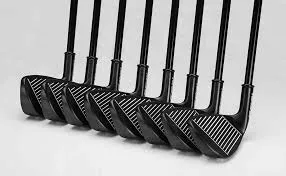
- What they do: Compact, minimal offset, tight shaping. Maximum Feedback and shot control.
- Who they suit: Low-handicap and single-digit players who strike the center consistently and want to shape shots precisely.
- Trade-offs: Very low forgiveness; poor turf interaction if you fat or thin it.
Takeaway: Match the head family to your consistency and goals (forgiveness vs workability). That narrows the field from dozens of models to a manageable shortlist.
How irons are measured: loft, lie, length, and gapping
These four specs matter more than model name or cosmetic differences. Focus here during fitting.
Loft
Loft controls launch, carry, and stopping power. Modern irons often have stronger lofts than historical counterparts; a current “6-iron” may fly like an older 5-iron. Always check manufacturer spec sheets and confirm carry on a launch monitor.
Lie
Lie angle is the shoe between shaft and ground at address. If the lie is too upright you’ll pull; too flat and you’ll push. Lie adjustments are inexpensive and recommended if your misses show a consistent face-left or face-right bias.
Length
Longer shafts add speed and distance but reduce control. Custom length matters: if you’re tall or short, get shafts cut to your posture. Tip-trimming and shaft tapering change feel and performance.
Gapping
Gapping is the yardage you carry between clubs. Target ~10–12 yards per iron for consistent scoring gapping; many fitters accept 10–15 yards as a workable band. Remember: roughly 1° of loft ≈ 3 yards carry, so 4° loft gaps produce ~12 yards.
The 9-step iron fitting checklist
Bring this checklist to any fitting session. Use it on your phone and have the fitter confirm each step.
- Baseline inventory: Bring your current irons. Record model, stated lofts, shaft specs, and three-shot average carry distances.
- Measure swing & ball speed. This helps choose shaft weight and flex. Ball speed charts map to shaft options.
- Evaluate launch & spin. Match a head/shaft combo that produces target launch and spin for your distance and stopping needs.
- Test loft variants. Test stock loft and at least one stronger/weaker loft to see which gives cleaner gapping.
- Try 2–3 shaft models, Steel vs graphite, different weights, and bend profiles. Small shaft differences can alter dispersion and feel.
- Check gapping. Confirm 10–15 yard carry gaps. If not, adjust the loft or add a hybrid/utility.
- Assess turf interaction. Test off mats and on turf if possible. Soles and bounce behavior matter in your course conditions.
- Confirm lie angle. Check for required uprighting or flattening after hitting a set of shots.
- Finalize grips & set composition. Confirm grip size, decide whether to include a 4-iron, hybrids, or add an extra wedge. Record final specs.
Pro tip: Use both data (launch monitor) and on-course feel; both matter. A set that looks good on numbers but feels wrong on turf probably isn’t right.
Best irons 2026: our tested recommendations by player type
Below are shortlists based on consistent lab testing and editor reviews across 2024–early 2026. Use them as a starting shortlist for fittings, not the final purchase decision.
Note: Model lines update often. Verify the latest specs before ordering.
Best for Beginners / Higher Handicaps, Maximum forgiveness
- Ping G730: Remarkable forgiveness, user-friendly launch, and solid turf interaction; high MOI and confidence-inspiring shape.
- Callaway Elyte HL / Elyte X High-launch designs that simplify long-iron play for slower swings; predictable flight.
- Tour Edge Exotics E725 (Value pick) Exceptional value: performance close to big brands at a lower price.
Mid-Handicaps Playability + Forgiveness
- TaylorMade P790 (latest) Players-distance look with surprising forgiveness; solid for improving ball-strikers.
- Mizuno JPX 925 Hot Metal: Great turf interaction, stable launches across the face; consistent distance control.
- Srixon ZXi5 / ZXi7 Balanced feel and forgiveness; ZXi7 often rated highly in independent player-iron tests.
Best for Low Handicaps / Single-digit Players
- Srixon ZXi7 (player’s option). One of the 2025/2026 lab favorites for control and feel.
- Mizuno Pro series / M-15 Forged feel, extraordinary feedback, and shaping ability.
- Titleist T-series (T150/T-series) Classic feel and shot control; Hot List staples.
Best Value / Budget Picks
- Tour Edge Exotics E725 / X725 High performance-per-dollar; recommended for golfers on a budget aiming for forgiveness.
How to choose shafts, grips & set composition
Shaft’s weight, flex, and kick point
- Shaft weight: Lighter graphite increases launch and helps slower swings; heavier steel stabilizes faster swings and reduces dispersion.
- Flex: Pick by ball speed (not ego). Too stiff → lower launch and less distance; too soft → ballooning and loss of control. Match ball speed to flex charts.
- Kick point (bend profile): A higher kick point produces a lower launch; a lower kick point produces a higher launch. Try at least two shaft models during fitting.
Grips
Grip size and texture affect release and control. Too large → blocked release, less distance; too small → excess wrist action and too much spin. Replace grips every 12–18 months or when tackiness drops.
Set composition
- Consider replacing long irons (3–4) with hybrids or utility irons for easier launch and better playability.
- Ensure wedge transitions (PW → AW → SW) close scoring gaps. If you have a 9-iron to PW gap > 10–12 yards, adjust lofts or add a wedge.
Pro tip: When building a set, list target carry distances per club and verify them during fitting. Don’t buy a set that leaves a 20-yard hole between clubs.
Loft & shaft gapping charts
Below are modern stock-loft references and target carry gaps. Use these as starting points always, and ensure your own carry distances.
Typical modern stock lofts & target carry gaps
| Club | Typical Stock Loft (°) | Target Carry Gap (yds) |
| 4-iron | 20–22° | 10–12 |
| 5-iron | 23–25° | 10–12 |
| 6-iron | 27–29° | 10–12 |
| 7-iron | 31–33° | 10–12 |
| 8-iron | 35–37° | 10–12 |
| 9-iron | 39–41° | 10–12 |
| PW | 43–46° | 8–12 (wedge gap) |
Common buying mistakes & how to avoid them
Mistake: Buying by looks, brand hype, or influencer picks.
Fix: Test on a launch monitor and confirm carry and dispersion.
Mistake: Not checking the actual lofts before buying.
Fix: Always check manufacturer spec sheets, lofts, and lie angles change across model years.
Mistake: Skipping shaft testing.
Fix: Test multiple shaft weights and flexes; small differences change ball speed and dispersion.
Mistake: Expecting an off-the-rack set to be perfect.
Fix: Budget for Minor Customizations: lie, shafts, grips. Custom spec often yields the largest performance gains.
Mistake: Ignoring turf/takeaway conditions during fitting.
Fix: Test on a turf surface similar to your home course to validate sole interaction.
Evidence from independent labs and Hot List testing consistently supports the same conclusion: fit matters as much as the model.
Maintenance & care tips for irons
- Clean after every round: Dirt in grooves reduces spin and control. A quick brush and towel wipe protects performance.
- Inspect grooves seasonally: Worn grooves reduce spin on approaches. Consider groove reconditioning if you need bite on approach shots.
- Check ferrules & shafts: Hairline damage can grow; repair early.
- Store dry: Avoid damp storage to prevent rust on uncoated heads.
- Regrip cycle: Replace grips every 12–18 months or when they lose tackiness.
- Resale value: Keep documentation of custom specs for resale and trade-in.
FAQs
A: Modern 6-iron lofts usually sit around 28°, but they can range from about 26° to 30° depending on the manufacturer. Always check the spec sheet for the exact number.
A: If you need forgiveness and distance, pick cavity-back/game-improvement. If you strike the ball consistently and want shot-shaping and feel, pick blades or players’ irons.
A: Yes. Lab testing and independent studies show fittings improve distance consistency, gapping, and dispersion. A 45–60 minute session with a certified fitter usually pays for itself in better performance.
A: If your clubs still fit your swing, irons can last many years. Replace when lofts/tech leave you at a measurable disadvantage (big gaps), feel declines, or you want a targeted upgrade.
A: Combine launch-monitor sessions (carry, spin, dispersion) with on-course testing to judge feel and turf interaction.
Final recommendations step-by-step
- Baseline test: Measure current irons’ carry distances (three shots per club) and record average carry and dispersion.
- Shortlist 2–3 models from the guide that match your handicap, goals, and price.
- Book a fitting with your checklist and test on a launch monitor plus on-course turf.
- Confirm Gapping and set composition before buying (aim for ~10–15 yards per iron).
- Order custom if you are serious about shafts, grip size, lie angle, and length matter more than cosmetics.
- Budget for adjustments and all spend on lie/shaft changes often improves performance more than buying a more expensive model off the rack.