


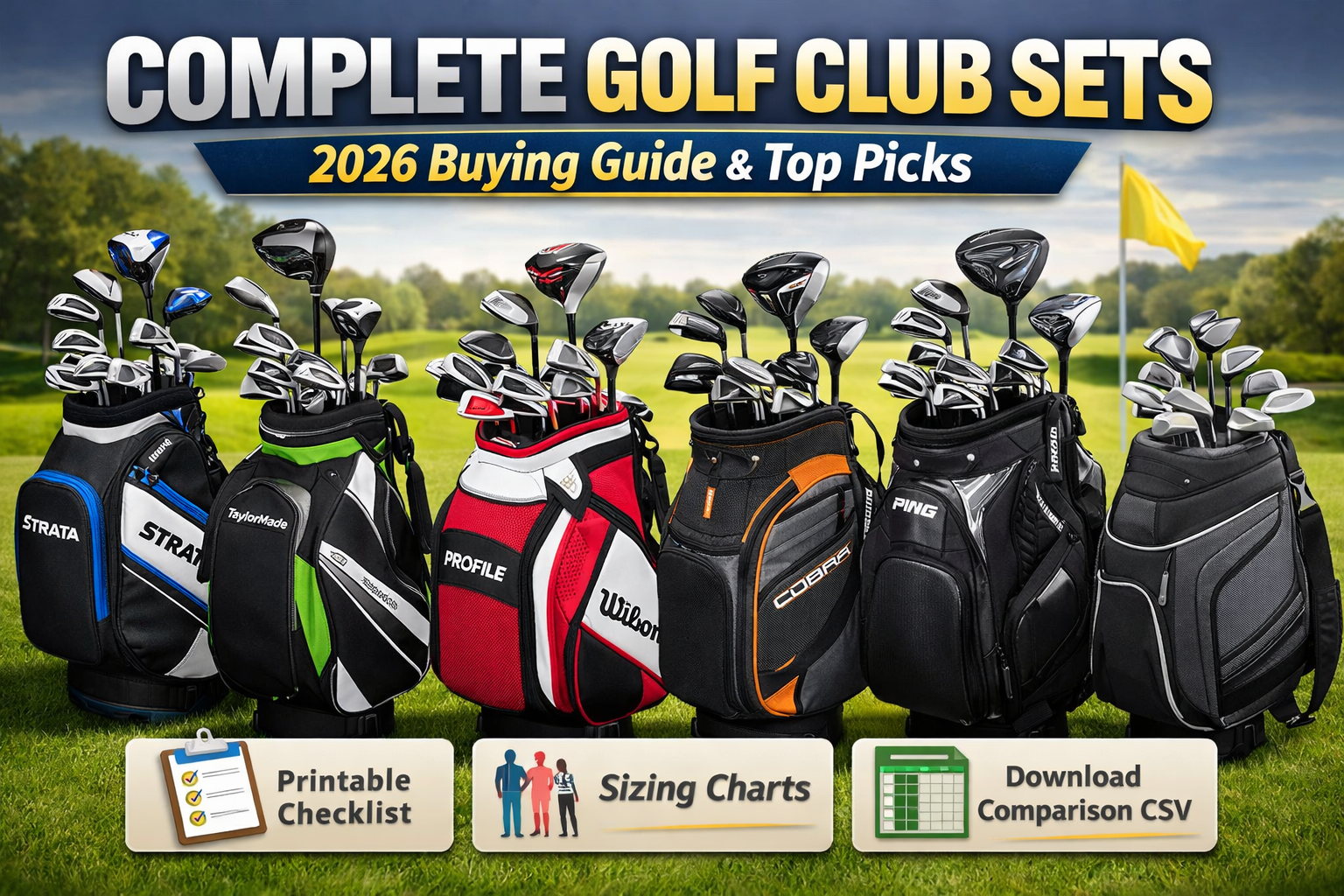
Introduction
Buying a Complete Golf-Club Set is the fastest, most predictable route from “I’ve never swung” to “I’m on the course.” For newcomers and casual players, a well-designed package behaves like a pre-trained model: the components were built to work together, reducing the friction of selection and the risk of glaring gaps. Good package sets provide coherent loft gapping, matched performance across clubs, and a lower price per club than buying component-by-component. But not every package is equal. Some are low-cost, cosmetically pleasing “box sets” that trade long-term playability for short-term appeal, while others are thoughtful value packages that will temper-field your growth for several seasons.
Quick decision: Which complete golf club set should you buy?
- Absolute beginner/budget ($350–$600): Buy a forgiving box set like the Callaway Strata style. Prioritise forgiveness and an easy-to-hit driver.
- Beginner → improving ($600–$900): Choose a mid-tier set (TaylorMade RBZ SpeedLite style). Hybrids replacing long irons and better stock shafts give growth potential.
- Serious / long-term ($900+): Consider a premium package or a hybrid strategy (buy a premium driver now, get fitted irons later). Avoid the cheapest box sets if you expect to progress fast.
What is a complete golf club set?
A complete golf club set (also called a “package set” or “box set”) bundles multiple clubs plus a bag in a single purchase. Think of it like a software distribution: everything arrives bundled, configured to interoperate, and ready to deploy. Typical contents include:
- Driver
3-wood (sometimes) - 5-wood or fairway wood
- 1–2 hybrids (often replacing long irons)
- Irons (commonly 6–9 to PW; sometimes 5–PW)
- One or two wedges (PW, SW, or gap)
- Putter
- Carrying bag with headcovers
Beginners often receive 8–12 clubs. Some premium packages include a full 14-club complement; always check the product specs so you don’t assume a full complement.
Why complete sets matter
Why they matter
- Cost efficiency: Sets usually cost less per club than buying one-by-one. Bundling reduces unit cost and simplifies checkout.
- Loft gapping out of the box: Good sets are engineered with progressive lofts so distances step logically.
- Ease of purchase: One transaction, one bag, consistent cosmetics, and ergonomics.
- Beginner-friendly specs: Light shafts, relaxed lofts on drivers, and forgiving head shapes reduce the early learning curve.
When they don’t
- Custom fit needed: Players with atypical swing speeds, unique physical geometry, or precise launch targets will outgrow default specs.
- Performance-focused players: Advanced players prefer custom fitting, aftermarket shafts, and specialised bends.
- Upgradeability: Low-cost box sets can be hard to incrementally upgrade; mixing premium components into cheap sets sometimes produces a mismatched feel.
Quick shortlist: Top 6 complete sets Shortlist & Quick Comparison
Use this short table near the top of the page for readers who skim. (Replace “example” product names with the exact models you carry for affiliate links.)
| Product (example) | Clubs Included | Ideal For | Price Range (approx) | Standout |
| Callaway Strata 16-Piece | Driver, 3-wood, 5-hybrid, 6–9, PW, SW, Putter, bag | Absolute beginners | $350–$499 | Highly forgiving, economical |
| TaylorMade RBZ SpeedLite-style | Driver, 3-wood, hybrid, 6–9, PW, Putter, bag | Beginner → improving | $600–$850 | Better shafts; upgrade-friendly |
| Wilson Profile SGI | Driver, fairway, hybrid, irons set, putter, bag | Seniors & slow swings | $400–$650 | Lightweight; high forgiveness |
| Cobra XL Complete | Driver, woods, hybrid, irons, wedge, putter, bag | Beginners who want modern shapes | $450–$700 | Modern design; large sweet spot |
| Ping G Series Complete | Driver, fairway, hybrid, irons, wedge, putter, bag | Growth-oriented beginners | $800–$1,200 | Strong performance & brand fit |
| Premium Package (Brand X) | Full 14 clubs; premium shafts; deluxe bag | Players wanting near-custom out of the box | $900–$1,500+ | Premium stock shafts; custom-like feel |
Placement tip: Use concise calls-to-action near each row for conversions (e.g., [Buy on Retailer]).
Head-to-head comparison features & pros/cons
| Feature / Set | Strata | RBZ SpeedLite | Wilson Profile SGI | Cobra XL | Ping G | Premium |
| Forgiveness | High | High–Med | Very High | High | Med–High | Med |
| Growth potential | Low | Medium | Low | Medium | High | High |
| Shaft quality (stock) | Basic | Higher grade | Lightweight | Basic-plus | Good | Premium |
| Gapping quality | Good | Good | Good | Good | Excellent | Excellent |
| Ideal swing speed | Slow–Med | Med | Slow | Slow–Med | Med | Med–Fast |
| Durability | Medium | Medium–High | Medium | Medium | High | High |
| Price value | Best | Very Good | Good | Very Good | Premium | Premium |
Quick takeaways
- Budget Box Sets (e.g., Strata) are excellent for a short-term beginner, gifts, or a first bag, but expect limited upgradeability.
- Mid-tier sets mix forgiveness with better shafts and an easier upgrade path, the best balance for players who plan to improve.
- Premium packages come close to a fitted feel; if you can afford them, they reduce short-term replacement but will still benefit from a final fitting.
Sizing & shaft guide (women, juniors, tall players)
Complete sets often offer gender- or height-specific options. Below is a practical guide:
Women & shorter players
- Female-specific sets typically use shorter shaft lengths, lighter shaft weights, and sometimes stronger lofts on irons to generate launch with lower swing speeds. If you identify as female or are physically shorter, start with women’s-specific sets or request a shorter-length option. Avoid choosing men’s full-length if you are shorter than the average adult.
Juniors
- Youth sets are sized by height brackets (example: 4’0″–4’6″, 4’7″–5’0″, 5’1″–5’6″). Use age and height to pick the bracket. Youth graphite shafts are common and appropriate until swing speed stabilises.
Tall players
- Look for “long-length” options or plan to have shafts extended. Many box sets don’t offer long-length; factor in a club-shop extension or look for manufacturers that sell “Tall” versions.
Interactive idea (on live site): Embed a height→shaft-length calculator for quick personalization to improve conversions.
Loft gapping simple test
Why gapping matters: Proper loft progression prevents yardage holes where no club fits a given distance. Bad gapping increases the chance you’ll have to guess or rely on poor clubs under pressure.
Simple gapping test (range test):
- Hit 3–5 solid shots with each club at the range.
- Record the carry distances (use a phone notes app or spreadsheet).
- Compute the average carry for each club.
- Check gaps aim for ≈10–20 yards between mid-irons; 18–22 yards between long clubs and hybrids.
- If any gap is >20 yards, consider adding a hybrid or changing the loft on the club that creates the hole.
Conversion idea: Offer a downloadable CSV that automatically flags gaps >20 yards so users can see which clubs to change. Competitor pages often skip this practical tool; add it.
How we test: metrics that matter
To build trust for both readers and search engines, publish your methodology. Key metrics to include:
- Forgiveness: Measured via distance loss and dispersion from off-centre impacts.
- Average carry & ball speed: Use a single launch monitor model for consistency.
- Distance consistency: Report standard deviation of carry for each club (N ≥ 10 shots recommended).
- Gapping: Average yards between clubs.
- Build quality & longevity: Longitudinal user-panel feedback and warranty checks.
- Playability across swing speeds: Run tests for 70–95+ mph ball speeds.
Methodology note for AhsanSportsGear.com: Use one launch monitor consistently, test indoors with controlled conditions, collect at least 10 shots per club, and publish the raw CSV.
In-depth reviews: Top 6 sets
For each set below, give an actionable mini-review: what it is, standout features, price bracket, ideal user, and pros/cons.
1) Callaway Strata 16-Piece: Best budget starter
What it is: A forgiving value set for solute beginners.
Standout features: Oversized heads, easy-launch driver, includes a cart bag and headcovers.
Price: $350–$499 (approx.)
Ideal for: New players, gifts, casual golfers.
Pros: Low price, forgiving heads, complete bag.
Cons: Basic stock shafts; limited growth as skills improve.
2) TaylorMade RBZ SpeedLite-style Best for growth
What it is: Mid-tier set with better stock shafts and playability.
Price: $600–$850
Ideal for: Players who expect to improve quickly.
Pros: Better shaft quality, hybrid replacements for long irons.
Cons: Pricier than entry-level sets.
3) Wilson Profile SGI Best for seniors / slow swing speeds
What it is: Lightweight package tuned for slower swing speeds.
Price: $400–$650
Ideal for: Seniors and golfers needing a lighter kit.
Pros: Easy to swing, very forgiving.
Cons: Slightly lower top-end distances.
4) Cobra XL Complete Modern forgiving package
What it is: Modern design with a forgiving face and a large sweet spot.
Price: $450–$700
Ideal for: Beginners wanting modern style and tech.
Pros: Contemporary shaping and forgiveness.
Cons: May need upgrades as skill improves.
5) Ping G Series Complete Best near-premium package
What it is: Higher-quality set with better stock shafts and construction, a higher-quality–$1,200
Ideal for: Players Seeking Longevity and better baseline performance.
Pros: Durability and performance.
Cons: Higher cost; still benefits from a fitting.
6) Premium Brand Package (14-club) Near-custom out of the box
What it is: Full 14-club package with premium shafts and the deluxe bag.
Price: $900+
Ideal for: Players wanting higher performance with minimal fitting.
Pros: Premium components; near-custom feel.
Cons: High cost; may still require fine-tuning.
After purchase: 6–12 month upgrade roadmap
Competitors often forget to guide buyers post-purchase. This roadmap reduces returns and keeps customers engaged.
0–3 months
- Track distances for each club (use the printable checklist & CSV).
- Don’t rush upgrades give yourself time to learn the set.
3–6 months
- If a gap >20 yards appears, add a hybrid or wedge.
- Evaluate the putter based on short-putt performance.
6–12 months
- If scores and swing consistency improve, consider a custom fitting for driver or irons.
- Driver upgrade yields the largest single-club payoff for many players.
1 year+
- Consider piecing together a half set of premium clubs (driver + irons) while keeping usable parts of the original set (putter, fairway woods).
Maintenance & care tips
- Clean grooves after each round using a soft brush and warm water to preserve spin.
- Dry clubs before storage to avoid rust.
- Check grips annually; replace when tackiness fades (12–18 months for regular players).
- Inspect ferrules & heads, fix loosening heads quickly.
- Bag care: dry zippers and ba, to avoid mildew; replace headcovers as needed.
Common mistakes to avoid when buying a complete set
- Buying purely on looks or brand.
- Ignoring shaft flex and weight.
- Assuming all sets include 14 clubs, many do not.
- Not checking the return policy.
- Skipping gapping checks after purchase.
FAQs
A: Yes, for beginners and casual players, they’re cost-effective and playable. As you improve, you may want to custom-fit key clubs.
A: Most complete sets range from 8–12 clubs; premium packages sometimes include 14. Always check product details.
A: Graphite is lighter and helps slower swing speeds (beginners, women, seniors). Steel gives consistent feedback for intermediate players.
A: Yes, common upgrade path: driver first, then irons or wedges. , ch gapping so new clubs fit the set.
A: Very. Proper gapping prevents yardage overlaps or big gaps; test distances after purchase and adjust as needed.
Conclusion
Complete golf club sets are one of the best ways into the game: economical, playable, and easy to buy. For most golfers, a mid-tier “grow with me” set offers the best balance of forgiveness, durability, and upgrade potential. Track distances, check Loft Gapping in the first 3–6 months, and plan a measured upgrade (driver or fitting) as you improve.