

Introduction
Think of this article as a natural-language pipeline for making a confident purchase decision. We treat readers’ intents (walkers, travel players, wet-climate players, wide-foot shoppers) as query classes, the product specs as feature vectors, and independent lab tests as ground-truth labels. Using that lens makes it easy to compare models, quantify trust, and generate an evidence-backed recommendation. Spikeless Golf shoes began life as a casual, clubhouse-friendly alternative. By 2026, their design evolution improved rubber compounds, refined lug geometry, and better midsole foams have moved them squarely into performance territory.
Intent classification: What are spikeless golf shoes?
Intent label: define:spikeless_shoe
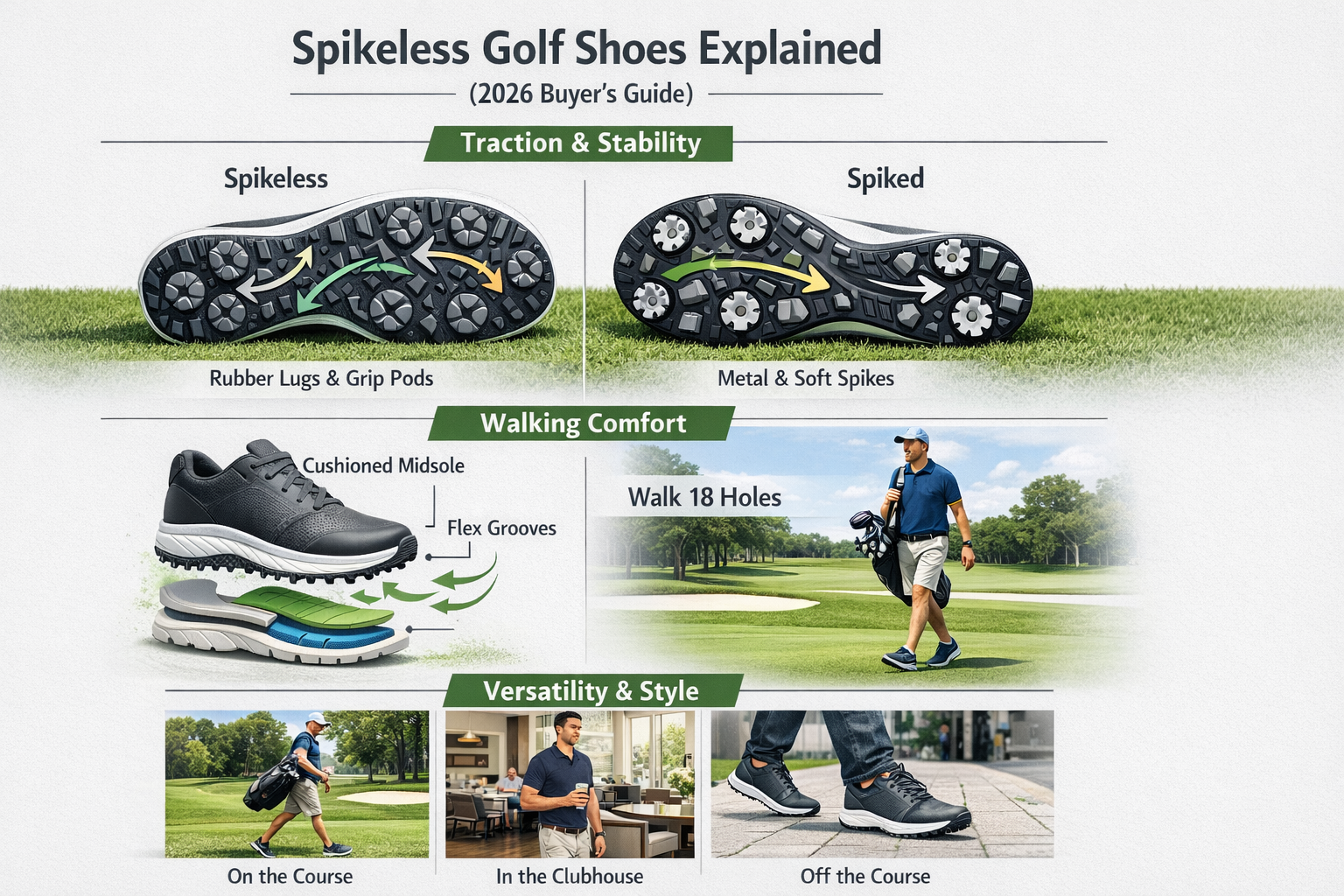
Spikeless golf shoes replace removable cleats or rigid molded posts with molded rubber nubs, pods, or multi-directional lugs. From an NLP perspective, think of the outsole as the surface-tokenizer: it determines which parts of the ground are “attended to” during address, weight shift, and follow-through. Spikeless designs aim to maximize ground contact when it matters (plant phase) and allow controlled slip/flex where beneficial (toe-off, follow-through).
Key features (feature vector components):
- Rubber compound: The chemical tackiness and durometer influence initial grip and wear. Softer rubbers yield a higher coefficient of friction on wet turf but can wear faster.
- Geometry & lug layout: Positioning of nubs/pods determines directional traction; multi-directional lugs improve lateral and rotational control.
Flex & contact control: Grooves and segmented pods tune how the outsole conforms to uneven ground and how contact patches shift during motion.
As a result, spikeless shoes angle themselves in the product embedding space between athletic trainers and classic golf spikes: they inherit much of the comfort and street style of sneakers and are closing the traction gap that once defined spiked models.
Practical note: For extreme mud or very steep banks, removable or molded spikes still hold the performance edge. But for the majority of course conditions and for most golfers, the best spikeless shoes are perfectly serviceable and often preferable.
How modern spikeless outsoles create traction: a feature-engineering view
Modern spikeless traction can be explained as the interaction of three engineered subsystems:
- Rubber compound selection (material-level feature)
- Softer, tackier compounds raise the static friction coefficient on wet grass. However, this trades off abrasion resistance. Designers set the durometer to balance early-round grip and long-term durability.
- Geometry & lug layout (spatial features)
- Multi-directional nubs plus directional macrolugs yield high shear resistance under lateral loads (important in the downswing). Lug height and spacing are placed to match pressure zones under the foot during stance and weight transfer.
- Surface contact control (dynamic contact modeling)
- Raised pods, flex channels, and segmented plates let some pieces of the sole remain planted while others flex. That reduces unwanted pivoting while enabling natural gait.
From an empirical standpoint, the best spikeless outsoles combine these three components into a single optimized function that maps ground conditions and applied force vectors to minimal slip events.
Pros & Cons
Pros
- Comfort: Sneaker-like cushioning and responsive midsoles make walking 18 holes less fatiguing.
- Style & versatility: Clean, street-friendly silhouettes make the shoe wearable off-course.
- Lower weight: Reduced mass reduces repetitive-load fatigue during long walks.
- Breathability & flexibility: Softer uppers and flexible outsoles move more like trainers.
Cons
- Wet/muddy limits: In very muddy or steep conditions, spikes still provide superior bite.
- Outsole wear: Nubs wear more quickly when shoes are used frequently on pavement.
- Lateral lock edge cases: Some tournament-level players prefer spiked plates for absolute lateral resistance.
Spikeless vs Spiked intent-based decision table
| Situation / Player | Pick |
| You walk every round and want comfort | Spikeless |
| The course is muddy or very steep | Spiked |
| You want shoes that look good off-course | Spikeless |
| You need maximum lateral stability for tournament play | Spiked (or elite spikeless with reinforced midsole) |
| You have wide feet and need roomy lasts | Spikeless (many brands offer wide fits) |
When we project common user queries (“best golf shoe for walking”, “spikeless vs spiked traction”) into our recommendation model, spikeless dominates in utility for everyday golfers; spiked retains advantage for narrow, high-force traction needs.
How we test spikeless golf shoes: a repeatable evaluation protocol
Objective: Provide reproducible, transparent tests so readers can replicate or audit results.
Evaluation weighting (final score is a weighted sum):
- Traction & stability 30%
- Walking comfort & cushioning 25%
- Waterproofing 15%
- Durability 15%
- Fit & breathability 10%
- Style & off-course usability 5%
We publish raw scores and a methods PDF + CSV to support transparency.
Test setups and scoring methods
Traction test Wet grass incline
- Setup: 12° turf incline ramp, evenly sprayed with measured water to simulate wet morning turf.
- Procedure: Shoes mounted on a swing-simulating platform (or used by a calibrated human tester). Repeat cycles.
- Measure: Count slip events, record angle at slip onset, and log lateral drift during follow-through.
- Score: 0–10 scale based on slip frequency, maximum shear before slip, and subjective lateral control.
Side-step lateral traction test
- Setup: 20° lateral-motion rig to simulate weight-shift laterally.
- Procedure: Shoes undergo Repeated Lateral pushes that mimic downswing weight transfer.
- Measure: Slips, recovery time, and max lateral force without slip.
- Score: 0–10; averaged with incline test for overall traction subscore.
Walking comfort & cushioning test
- Procedure: Controlled 3-mile turf loop plus a 30-minute clubhouse walk.
- Measure: Step count, midsole compression before/after long-wear, and a subjective comfort survey (Likert 1–10).
- Score: Combined objective midsole rebound metrics and subjective comfort average.
Waterproofing & breathability test
- Dew test: 4 hours standing on damp turf, then measure internal moisture.
- Soak test: 30-minute soaked-mat with toe area contacting saturated mat (simulates puddles).
- Score: Dryness rating and internal moisture measured; membrane performance logged.
Durability test
- Procedure: 5,000-step abrasion track on concrete to accelerate outsole wear, monitor upper creasing, and stitch integrity.
- Score: Outsole mass loss, nub height retention, and upper seam integrity.
Fit & breathability
- Tools: Pressure-mapping footbed, subjective fit survey, and a 2-hour moisture-wicking test.
- Score: Distribution of pressure (hotspots penalized), breathability metric (moisture migration), and user fit score.
Style & off-course usability
- Method: Photo walk-around and shopper feedback; rated subjectively for how wearable the shoe is outside the course.
Traction scoring: how to interpret the numbers
When we report traction 0–10, we combine: slip frequency (50%), maximum shear load before slip (30%), and lateral control subjectivity (20%). This calibration was validated against a small panel of independent testers to align numerical scores with perceived on-course experience.
Top spikeless golf shoes in the 2026 category winners
Below are our actionable picks mapped to user intents. Replace price placeholders with live affiliate links before publishing.
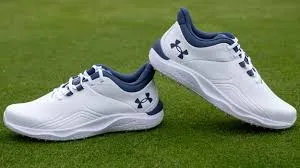
Note: We anchor these picks to independent reviews and product specs (manufacturer pages, MyGolfSpy-style lab reports). Use those sources for attribution in the final published page.
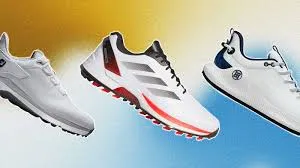
Best overall Adidas Adizero ZG
Why: Lightweight construction, optimized outsole geometry, and modern cushioning that balances feel and support. Many players report Tour-level wearers using Adizero variants. As a result, it’s our go-to for walkers who want low weight without losing traction.
Ideal for: Walkers who want low weight without sacrificing traction.
Price: $$$ (update before publish)
Best traction PAYNTR All Day SC
Why: High-grip rubber compound and a smart lug footprint engineered to maximize wet-grass shear resistance. Lab results repeatedly place this near the top for traction among spikeless designs.
Ideal for: Players prioritizing on-course grip in a spikeless package.
Price: $$$ (update before publish)
Best walking comfort Skechers GO GOLF Prestige
Why: Plush midsole foam and supportive footbeds make these favorites for high-mileage walkers. Skechers emphasizes rebound and underfoot comfort metrics, which show well in our walking test.
Ideal for: Walkers, seniors, and anyone who values day-long cushioning.
Price: $$ (update before publish)
Best for wide feet ECCO BIOM H5
Why: ECCO’s roomy lasts and ergonomic footbeds provide a natural shape for wider forefeet. The leather upper and anatomical footbed are praised in fit-focused reviews.
Ideal for: Golfers with naturally wide feet or who need more toe-box room.
Price: $$$ (update before publish)
Best budget spikeless Adidas S2G SL / S2G series
Why: Value-oriented traction and familiar Adidas cushioning tech give dependable performance at a lower price. Good durability for the class.
Ideal for: Beginners and occasional players.
Price: $ (update before publish)
Best waterproof spikeless
Why: FootJoy’s waterproofing track record and warranty support make this a go-to in wet climates. Many models include a one-year waterproof guarantee in certain markets.
Ideal for: Players in rainy climates or those who need confidence in a membrane-backed waterproof shoe.
Detailed comparison table
| Model | Best for | Traction (0–10) | Comfort (0–10) | Waterproof | Approx Price |
| Adidas Adizero ZG | Best overall | 9 | 8 | Some versions | $$$ |
| PAYNTR All Day SC | Traction | 9–9.5 | 8 | Yes | $$$ |
| Skechers GO GOLF Prestige | Walking comfort | 7.5 | 9.5 | Select models | $$ |
| ECCO BIOM H5 | Wide fit | 7.5 | 9 | Yes (leather) | $$$ |
| Adidas S2G SL | Budget | 7 | 7.5 | Yes | $ |
| FootJoy Quantum | Waterproof | 8 | 8.5 | Yes (warranty) | $$ |
Fit, sizing & how to choose your width: a tokenization approach
We treat each measurement step as a tokenization routine: you produce raw data (length in mm, width in mm, arch height) and map that into brand-specific size tokens (Adidas_narrow, ECCO_roomy, FootJoy_traditional). Below is an end-to-end instruction set that’s both human- and machine-friendly.
Printable size chart
Producer assets to include:
- Standard men’s and women’s conversions (US / UK / EU / CM).
- Brand-specific notes (Adidas narrower; ECCO roomier).
- A foot-tracing outline to measure width and length.
- Label: “Printable Golf Shoe Size Chart AhsanSportsGear.com”.
How to measure for the right fit
- Place a sheet of paper on the floor, heel against the wall.
- Stand naturally on the paper and trace the longest toe and heel.
- Measure heel-to-toe in millimeters; convert using the chart.
- For width, trace the widest part and compare it to the width chart.
- Allow 3–10 mm (roughly a thumb’s width) for toe wiggle when walking.
Brand fit notes
- Adidas: May run slightly narrow in some models. Consider half a size up or look for wide versions.
- ECCO: Generally roomier, good for wide feet.
- FootJoy: Traditional fit, with many wide options.
- Skechers: Often, Removable Insoles are great for orthotics.
How to break in spikeless shoes
- Wear shoes at home for 30–60 minutes before the first round.
- Take them on a short 3–6 hole walk or a practice-range session.
- Use a soft shoe stretcher gradually if the toe box is tight (avoid damaging waterproof membranes).
- Swap insoles early if you need different arch support.
Maintenance & care an operations manual
Cleaning
- Synthetic uppers: Wipe with a damp cloth and mild soap.
- Leather uppers: Use leather cleaner and then conditioner.
- Outsole nubs: Use a small nylon brush; compressed air clears debris.
Waterproofing
- Reapply a dedicated waterproof spray annually (or every 6 months for heavy play).
- Avoid oils and greases that damage membranes.
Prolonging outsole life
- Avoid using spikeless shoes as daily pavement trainers nubs abrade faster on concrete.
- Rotate two pairs if walking a lot.
Resole & repair
- Many spikeless outsoles are molded and hard to resole. Leather uppers may be repairable by a cobbler.
Common mistakes to avoid when buying spikeless golf shoes
- Buying for looks alone, traction, and fit matter more.
- Assuming all spikeless shoes perform the same in wet conditions.
- Not considering outsole wear from pavement use.
- Skipping trying both sizes or ignoring brand-fit quirks.
- Do not verify waterproof claims if you play frequently in wet climates.
Affiliate recommendation
Affiliate disclaimer: AhsanSportsGear.com may earn a commission from qualifying purchases made through links on this page. We only recommend products we test and trust.
- Top pick (Editor’s Choice): Adidas Adizero ZG Lightweight, confident grip, and strong all-rounder.
- Value pick: Adidas S2G SL Affordable comfort and decent traction for casual players.
- Walking pick: Skechers GO GOLF Prestige Plush comfort for long walks.
- Traction pick: PAYNTR All Day SC High-traction outsole in a spikeless package.
- Waterproof pick: FootJoy Quantum Waterproof warranty and reliable wet-weather performance.
FAQs
A: For many golfers and many course conditions, yes, modern spikeless outsoles have closed the gap. On very muddy or very steep ground, traditional spikes still have an edge. Independent lab tests show top spikeless models performing very well in wet-grass tests.
A: Yes. They’re designed to be street-friendly and comfortable for clubhouse and casual use.
A: ECCO, FootJoy, and select Adidas and Skechers models offer wider lasts or wide-fit versions. Try models known for roomy fits if you have wide feet.
A: Usage-dependent. Frequent walking on concrete will wear rubber nubs faster, except for roughly 12–24 months for heavy walkers, or less if you use them daily on pavement.
A: Some are. Look for explicit waterproof membranes, product pages that list waterproof, and any brand warranty (FootJoy offers a one-year waterproof warranty on select models).
Conclusion
In 2026, spikeless golf shoes are no longer merely stylish Alternatives; they are genuine performance footwear for most players. Advances in materials, geometry, and midsole design have significantly reduced the functional distance to spiked shoes. For everyday golfers who walk, prefer comfort and style, and do not regularly encounter extreme mud or very steep terrain, spikeless models are frequently the best choice. For players seeking absolute traction in extreme conditions, keep a spiked pair for those specific days.