


Introduction
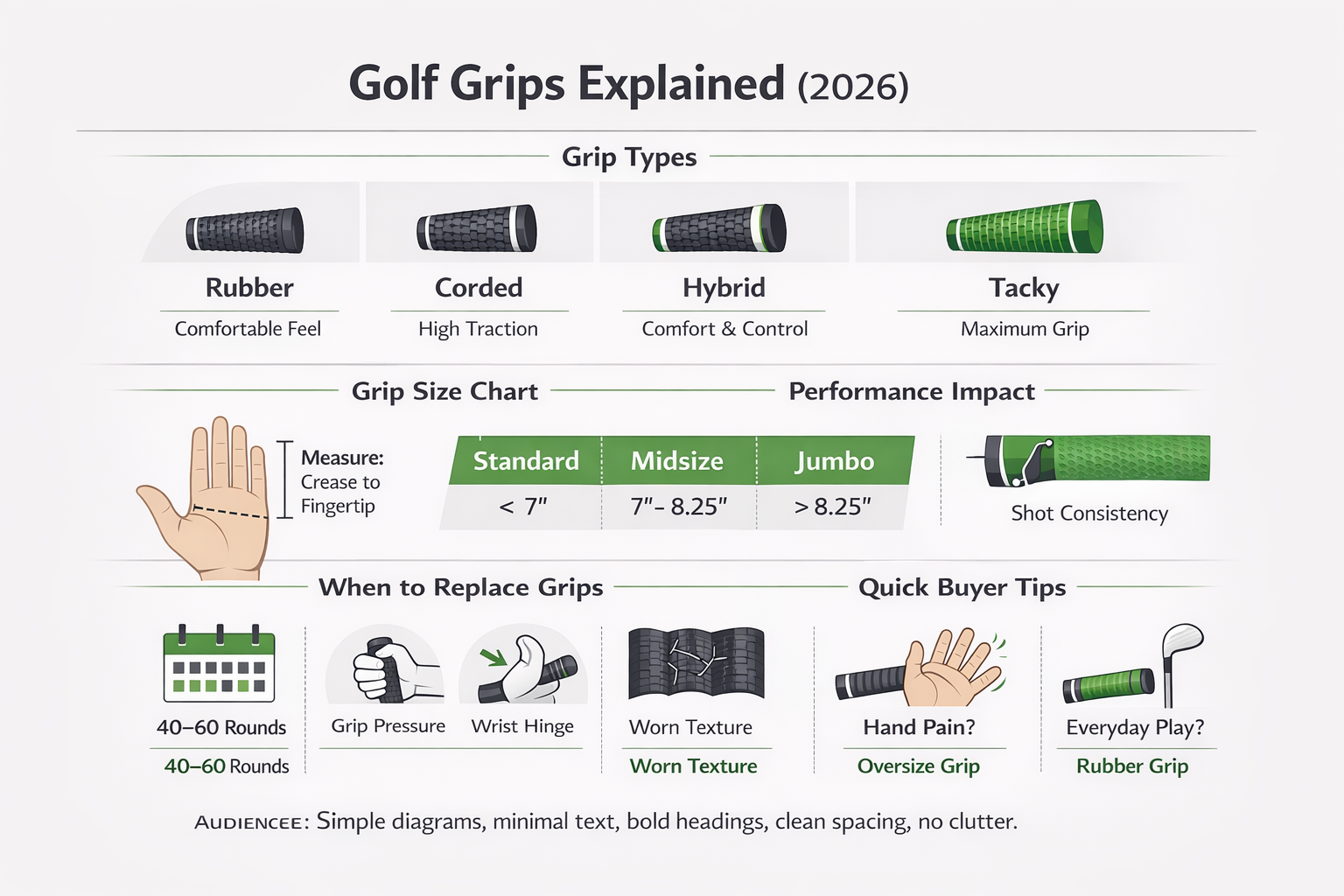
Golf Grips are the only connection between your hands and the club, and the right grip can make a noticeable difference in comfort, control, and shot consistency. Many golfers overlook grips, yet grip type, size, and condition directly affect swing tension, wrist movement, and accuracy. This visual guide breaks down golf grip types, sizing, performance impact, and replacement timing, helping you choose the best grip for your game in seconds. Whether you’re upgrading worn grips or fitting a new set, this infographic makes the decision simple and clear.
Why the right golf grip matters
Your grip determines how the clubface sits at impact, how your wrists hinge through the swing, and how much tension you hold in your hands. Even small adjustments to grip type or size can have large, immediate effects on shot shape, distance, and consistency. A wrong grip size or a worn grip forces you to squeeze harder. Extra squeeze shortens your swing arc, reduces clubhead speed, and adds variability to release, which means the ball lands left or right unpredictably. Conversely, the right grip reduces unnecessary tension, increases comfort, and helps you repeat the same hand setup every time.
How grips affect performance
- Tackiness/friction: A tackier grip requires less squeeze and gives more immediate feel; useful for players who prefer minimal hand pressure.
- Thickness/size: Too large reduces wrist hinge and distance; too small increases hand action and can cause hooks. The goal: the smallest diameter that still allows natural wrist motion.
- Texture/cord: Corded or textured grips provide traction in wet conditions but can be harsher on bare skin.
- Material & compound: Rubber, polymer, or blended compounds determine comfort, durability, and wet-weather traction.
- Taper & profile: Some grips have raised ribs, alignment aids (Align-style), or reverse tapers to support specific hand positions or putting strokes.
Grip types & materials, which one is right for you?
Below are the main grip families, what they feel like, and when to use them.
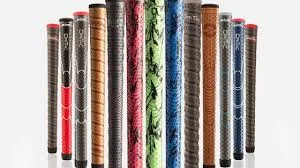
1. Rubber / Synthetic (Tour Velvet style)
What: Soft rubber compound with a velvet-like texture.
Feel: Cushioned, slightly plush.
Best for: Most recreational players seeking comfort and feel.
Tradeoffs: May lose traction in heavy rain compared with corded options.
2. Corded
What: Fibers or cord embedded or braided into the grip compound.
Feel: Firmer and rougher, excellent traction.
Best for: Wet/humid climates and players who sweat a lot.
Tradeoffs: Can feel harsh on bare hands and dampen some sensory feedback.
3. Multi-compound / Hybrid (e.g., MCC by Golf Pride)
What: Different compounds in upper vs lower sections (soft top, firmer lower).
Feel: Comfort where your top hand sits; control where your lower hand needs stability.
Best for: Players who want both feel and traction.
4. Tacky / Specialty (Iomic, Pure, sticky rubbers)
What: Extremely tacky polymers or formulations.
Feel: Very sticky reduces the necessary squeeze.
Best for: Players wanting maximum hold with minimum effort; popular on putters and wedges for repeatable hand placement.
Tradeoffs: Tacky compounds can attract dirt and may age sooner.
5. Putter Grips (oversize, reverse-taper, pistol)
What: Larger diameter or special tapers designed to limit wrist action.
Feel: Stabilizes hands and reduces wrist movement.
Best for: Putting styles that benefit from reduced wrist motion or players with hand pain.
Quick one-line table:
Rubber → Comfortable → Can slip in rain.
Corded → Best wet traction → Rougher on hands.
Multi-compound → Balanced → More expensive.
Tacky → Max stickiness → Attracts grime.
How to find your grip size measure & decide
Getting the size right is one of the most impactful changes you can make.
1) Measure your hand (simple, reliable method)
- Use your upper grip hand (left hand for right-handed players).
- Open your hand and find the crease at the base of your palm.
- Measure from that crease to the tip of your middle finger.
- Compare the result to a grip-size chart (Standard, Midsize, Jumbo). Many manufacturers (Golf Pride, Lamkin) publish exact ranges.
2) Use your glove size as a shortcut
If you already know your glove size, many brands map glove-size to grip-size. It’s a quick proxy but not as precise as the hand-measure.
3) Quick fit test on the course
- Hold the club normally.
- If you must grip tightly to stop the club from twisting, try a slightly larger grip (+1/16″).
- If a larger grip shortens the wrist hinge and reduces distance, go down a size.
Rule of thumb: pick the smallest grip that still permits natural wrist movement.
Which grip for which golfer, quick decision flow
Answer these three questions to narrow options:
- Do you play often in wet/humid conditions?
- Yes → Corded or hybrid (corded upper).
- Do you have hand pain or arthritis?
- Yes → Oversize or reverse-taper, soft compounds.
- Do you want maximum feel or maximum traction?
- Feel → Soft, tacky compounds. Traction → Corded/hybrid.
Profiles:
- Sweaty hands / humid climate: Corded or multi-compound.
- Seniors/arthritis: Oversized & softer compounds.
- Power hitters: Slightly thinner, firmer grips for precision.
- Everyday player: Tour Velvet or MCC-style grips.
Top tested picks
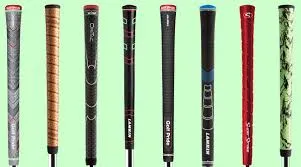
Below are eight picks commonly recommended in 2025–2026 roundups. Use these one-liners on product cards and expand into long reviews on the page.
- Golf Pride Tour Velvet / Tour Velvet 360 Classic all-rounder: comfortable, reliable, widely used.
- Golf Pride MCC / MCC Plus4 Hybrid comfort + control; soft upper, firmer lower.
- Golf Pride CPX / CP2 Wrap: Tacky Feel with raised pattern; repeatable placement.
- Lamkin Crossline / Sonar+ Value and wet performance; durable and budget-friendly.
- Winn Dri-Tac Soft polymer with shock absorption; great for long practice sessions.
- Iomic Sticky Maximum tack; niche but excellent for low-squeeze players and certain wedge/putter uses.
- SuperStroke (putter grips): Stabilizing putter grips that reduce wrist movement.
- JumboMax / Oversized grips for arthritic hands or arm-lock styles; stabilize hands and reduce wrist action.
Note: model names, SKUs, and prices change frequently; update product pages at publish time.
Publishable product comparison table
| Rank | Grip | Material / Type | Size options | Best for | Quick verdict |
| 1 | Golf Pride Tour Velvet / Velvet 360 | Rubber/velvet | Std, Midsize, Jumbo | Classic all-round | Balanced feel & wide use |
| 2 | Golf Pride MCC / MCC Plus4 | Multi-compound | Std, Midsize | Control + moisture management | Hybrid feel for varied conditions |
| 3 | CPX / CP2 Wrap | Tacky/patterned | Std | Tack & control | Raised pattern for repeatable placement |
| 4 | Lamkin Crossline / Sonar+ | Rubber / textured | Std, Midsize | Wet-weather value | Durable and budget-friendly |
| 5 | Winn Dri-Tac | Polymer | Std, Midsize | Comfort/beginners | Soft, cushioned feel |
| 6 | Iomic Sticky | Tacky specialty | Std | Tackiest/putters | Max tack niche preference |
| 7 | SuperStroke | Putter grip (oversize) | Oversize | Putting stability | Reduces wrist action |
| 8 | JumboMax | Oversize | Jumbo | Arthritis / arm-lock | Stabilizes hands & stroke |
How often should you replace grips?
Typical guideline: replace grips every 40–60 rounds or roughly once a year for average players. But frequency depends on use, climate, and product:
- Frequent range rats: consider replacing every 6–9 months.
- Humid climates/sunscreen & oils: replace sooner.
- High-end tacky grips: may need replacement sooner due to surface wear.
Signs you need new grips:
- Grip feels slick even after cleaning.
- Texture grooves are flattened or shiny.
- Visible cracks, splits, or separation at the butt.
- Increased hand tension or decreased shot consistency.
How to regrip step-by-step
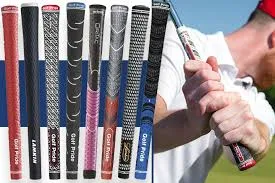
Regripping is cheap, fast, and a great DIY project. Do a single iron first as a test before doing the whole set.
Tools you’ll need
- New grips (buy one to test first).
- Double-sided grip tape.
- Grip solvent (or citrus solvent).
- Hook blade/utility knife (for old grips).
- Vice or clamp (rubber jaws recommended).
- Rag & bucket of soapy water.
- Finishing tape (for butt cap) and cap remover if needed.
Steps
- Remove the old grip. Cut the old grip lengthwise with a hook blade and peel it off.
- Strip old tape. Remove tape residue from the shaft; use solvent if needed.
- Prepare a new tape. Apply double-sided tape from the butt to the ferrule; keep edges smooth and leave a vertical seam for alignment marks.
- Apply solvent. Pour a little solvent into the new grip and over the taped shaft; you want enough to lubricate but not flood.
- Slide on the grip. Push the grip onto the shaft quickly, lining up any alignment marks. Seat it fully.
- Align & hold. Keep the grip steady until the solvent is absorbed (usually a minute or two). Wipe off excess.
- Trim & finish. Trim excess butt tape if required and cap with finishing tape. Let cure ideally 12–24 hours before heavy play.
Common mistakes to avoid
- Re-using old tape (risk of slippage).
- Applying too much solvent (causes messy drips and potential rotation).
- Rushing Alignment (rotation ruins hand placement).
- When using substandard tape, always use double-sided golf grip tape.
DIY saves money: a full set can be regripped in an afternoon. Add a printable regrip checklist to your product pages to reduce return rates.
Maintenance & care
- Wipe grips after each round with a damp cloth to remove sweat and oils.
- Deep-clean monthly: mild soap, warm water, and a soft brush (don’t soak the shaft).
- Store clubs in shade; prolonged heat will degrade rubber compounds.
- Rotate grips: install one new grip on a short iron first before changing the whole bag.
- Avoid contact with sunblock or chemicals, as they accelerate compound breakdown.
Lifespan rules: replace when tackiness remains gone after cleaning, grooves look flattened, or small cracks form.
FAQs
Corded or multi-compound grips retain traction in humidity and rain.
Yes. Too large reduces wrist hinge and distance; too small increases hand action and inconsistency. Fit to your natural release.
Yes, with tape, solvent, and patience. DIY saves money and is straightforward.
Tacky grips reduce the required squeeze but can age faster and attract dirt; choose based on feel.
Conclusion
Choosing the right golf grip is one of the simplest ways to improve comfort, control, and consistency in your game. By matching the grip type to your playing conditions, selecting the correct size for your hands, and Replacing Grips before they wear out, you reduce tension and swing more freely. Use this guide to make smarter grip decisions, test one grip before changing your entire set, and keep your clubs performing at their best throughout the season.